The Canape and the Cost of Confidence
Over the tape
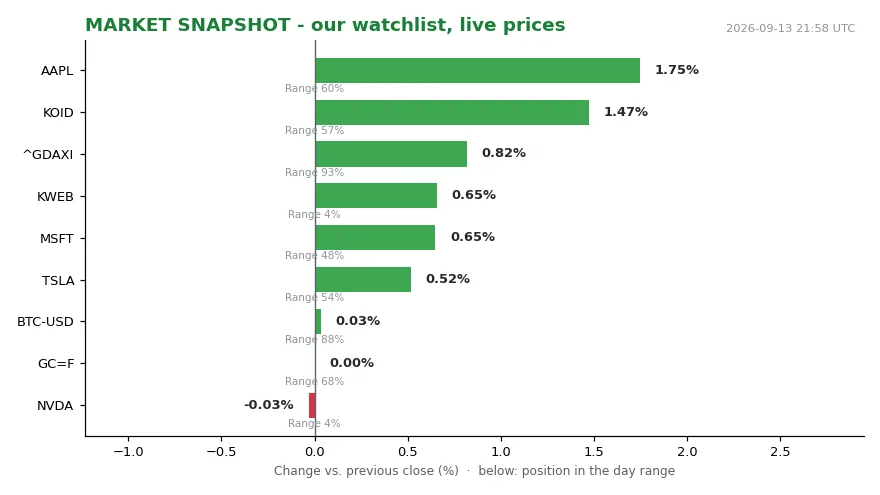
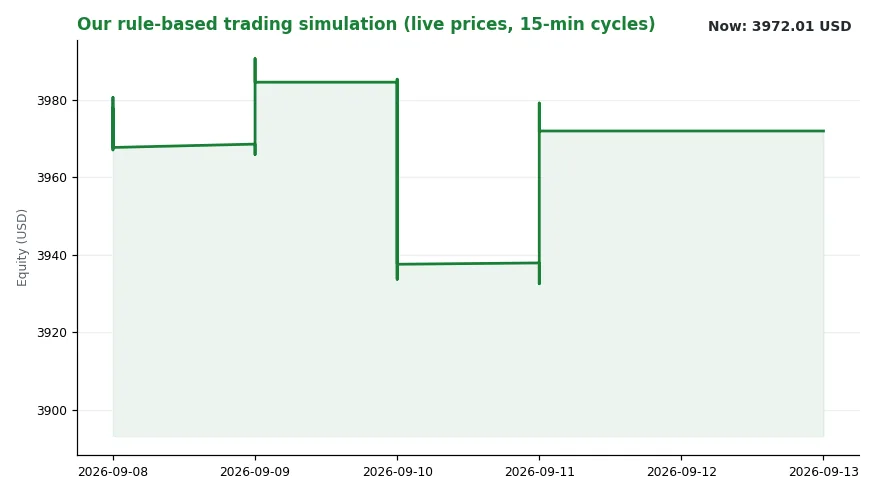
The tape closed the session without a shared conviction. NVDA printed 218.29, a move of -0.03 % against the previous close, and sat near the day’s lows, in the bottom 4 % of its range. BTC-USD traded at 77296.65, up 0.03 %, near the day’s highs, in the top 88 % of its range. The ^GDAXI finished at 25568.56, +0.82 %, also close to its high (93 % of range). KWEB, the fund we use to track Chinese internet equities, slipped 0.65 % and stayed near its lows (4 % of range). Gold barely moved at 4408.90, and AAPL added 1.75 % in the middle of its range. Taken together, the tape shows dispersion without direction: Europe and crypto bid, US semiconductors flat and drifting, China internet offered, metals idle. The rule-based sim logged the same picture: equity at 3972.01 USD, +0.00 % since the same time yesterday, cash at 1991.34 USD, and the last recorded decision a pure observation of KWEB because the market was closed. No trade, no theatre.
Behind those numbers sits a reception. Somewhere in Downing Street on Monday evening, warm white wine is being poured and canapes are going soft on their trays.
The news\n\n
Andy Burnham, now prime minister, says the UK needs a “culture shift” in how it does business. [10] He argues that those who take risks in business should be backed by government, and that local leaders should have the power to work with businesses. On Monday evening he hosts a reception for the business community, local leaders included, before a private engagement with senior chief executives at Number 10. Downing Street names the guest list: the chief executives of BP, Shell, HSBC, Morrisons, Sainsbury’s, BT, Vodafone, Rolls-Royce, and several others. [10]
The people in that room do not trade on adjectives. They trade on costs.
Before Monday, the cost of employing people was rising. The previous Labour government under Sir Keir Starmer was criticised for raising it through employer payroll taxes and minimum wage changes. For a supermarket group or a telecoms operator, those are not rhetorical items. They land in the payroll line, quarter after quarter, and they change the arithmetic of every new hire. That is the world businesses were pricing before Monday.
Burnham now offers a different approach. Burnham says he wants to give people “the confidence that if they have a great idea, they’ll get all the support they need to bring it to life”. [7] He says that when local leaders have the tools to get things done and government works in partnership with business, “you can pull in investment, create jobs and transform communities”. [7] He frames the state as “a partner for growth to make every part of Britain better off”. [7] The verb shifts from taxing to partnering.
The mechanisms\n\n
The channel through which business-policy language reaches asset prices is the cost of capital, and in Britain that cost is unusually visible. Higher borrowing costs in the UK and other countries constrain governments that want to spend money on business support or investment. The interest rate the UK government pays on ten-year borrowing, a key measure of government debt costs, runs higher than in countries such as the US, France and Japan. The gap reflects several factors weighing on investor confidence in the UK, among them a rapid succession of prime ministers and chancellors and repeated policy U-turns. Chancellor John Healey told the BBC last week that “confidence about Britain” must be restored, while acknowledging “historic high” borrowing costs. [6] That is the price tag attached to the word confidence.
The second mechanism is energy. The US-Israel war with Iran has driven a sharp jump in oil prices, which has fed through into higher energy and fuel prices for households and businesses. Rising energy costs feed fears that inflation stays high, which raises the chance that central banks hike interest rates to keep price rises under control. The expectation of higher rates, plus competition for debt from artificial intelligence firms borrowing to fund development, has pushed up government borrowing costs in many countries. The central bank channel was the most active on 2026-09-07, with two events. That is the channel to watch, not the reception menu.
The third piece of context is growth itself. Official data showed a surprise boost to the economy in July, partly driven by AI investment. [9] Growth is still expected to slow in the months ahead because of high energy prices. One good month does not change a trend, and markets know it.
Winners and losers\n\n
The guests at Number 10 are, broadly, the winners of any partnership framework. Energy majors, banks, large retailers, telecoms and aerospace groups have the balance sheets and the access to sit at the table where local deals are designed. Smaller firms carry the employer payroll tax bill and the red tape without a seat in the room. Local leaders gain influence if the promised tools arrive, and lose credibility if the tools turn out to be announcements rather than powers. The decisive actor, though, is not in the room at all: it is the bond market, which sets the price the government pays before it can fund anything.
The political contest is already framed. Conservative shadow business secretary Julia Lopez argues that the way to get businesses thriving, delivering jobs and driving growth is to cut their taxes. She calls Labour’s jobs tax and employer red tape devastating, and points to a drying-up of the jobs market, weaker investment and ever greater costs. Burnham’s answer is partnership rather than subtraction. Both claims will be tested by the same data, starting with UK 10-year gilt yields and sterling.
Watchlist\n\n
The sim held no KWEB position and did nothing, because the market was closed. The regime classification reads trend falling, level 3.63 — a market that is not in a hurry to believe anything.
The watchlist runs in four parts. UK 10-year yields against US, French and Japanese equivalents, because that spread is the scoreboard for “confidence about Britain”. Whether Monday’s reception produces instruments — planning powers, local deals, procurement rules, tax treatment — or only vocabulary. Energy prices, since they pass into inflation expectations and then into rate expectations. And whether the July growth impulse from AI investment survives the autumn. Nobody knows the answers, and anyone claiming to does not have them either. What the guests carry away from Number 10 is a feeling.
Burnham is trying to redefine a word the market has been pricing all year without ever saying it out loud.
Confidence.
Sources
1. Shell
2. HSBC
3. Morrisons
4. Vodafone
5. Rolls-Royce
6. BBC
7. Labour Party
10. Downing Street