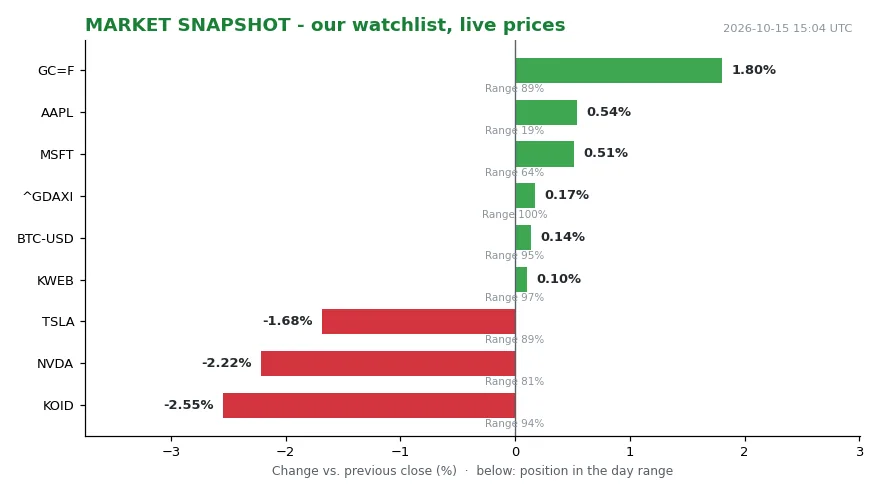
Our own tape at 14:59 UTC — quotes fetched zero minutes earlier — begins calmly. Nvidia prints 217.07, down 1.91 % against its previous close, yet sits near the top of its range at 97 %. Tesla trades at 361.20, off 1.62 %, also near its highs at 94 %. The AI-linked tracker KOID stands at 32.53, down 2.46 %, and is pinned at 100 % of its range. Microsoft is 0.69 % higher at 537.38, near its highs at 76 %. Apple breaks the pattern: 344.92, up 0.57 %, but near its lows at 22 % of range. Gold at 4,176.40 is up 1.67 % and near its highs at 80 %. Bitcoin changes hands at 81,802.02, up 0.28 %, at 96 % of its range. The DAX reads 25,331.46, up 0.13 %, at 98 % of range. KWEB, at 24.53, is up 0.08 % and at 96 %.
Taken together, a shape emerges. Nearly every instrument on our list — including the ones still red on the day — sits near the top of its own range. That is not the fingerprint of a market collapsing. It is the fingerprint of a market that took a hit early and then bought it back. The damage was front-loaded. The bid arrived later.
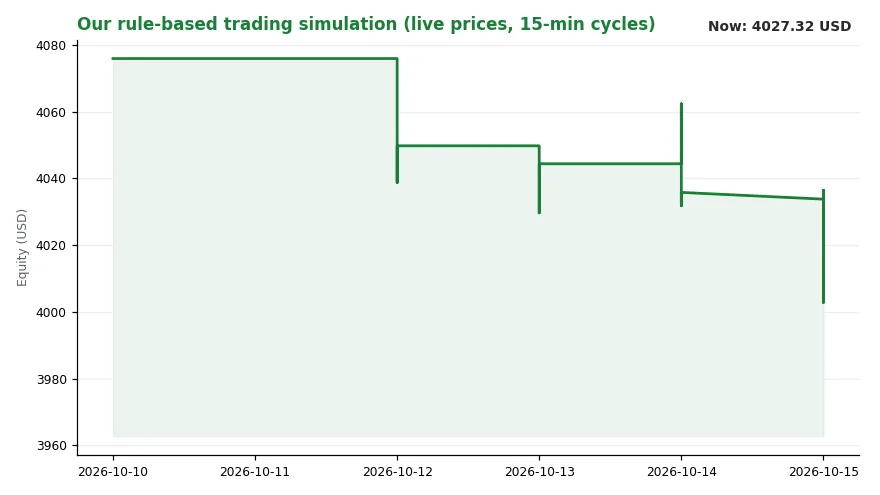
Two more of our numbers belong here. The rule-based simulation equity stands at 4,027.32 USD, down 0.21 % versus the same time yesterday, with 2,014.07 in cash. Its latest logged decision is a buy of Apple at 344.69, stamped 2026-10-15 16:41:07. That record is documented and mechanical, not a view on where prices go. The regime reading is trend=falling, level=3.63. The busiest signal channel today is central banks, with two events.
What the Seoul session made visible is not a price. It is a dependency. South Korea’s Kospi 200, an index weighted heavily toward memory-chip manufacturers, fell more than 8 % overnight to a six-month closing low. Circuit breakers halted trading at various points during the session. SK Hynix dropped nearly 11 %. Samsung Electronics fell 9.5 %. The index closed down 8.1 %.
The shock travelled. Japan’s Nikkei 225 lost 4.9 %. Kioxia, a memory-chip maker, slumped 11 %. SoftBank, a large investor in the owner of ChatGPT, fell 10 %. Wall Street had already weakened in the prior session, where the Nasdaq Composite fell 1.9 % and the S&P 500 dropped 1.1 % — its worst performance since July. When US trading resumed on Thursday, the Nasdaq fell another 1.4 %. Dell, which makes datacentre servers, and Coherent, which manufactures components for AI datacentres, led the early fallers.
Europe absorbed the rest at a distance. Germany’s DAX was down 0.36 % in afternoon trading. Italy’s FTSE MIB dropped 1.3 %. In China, the Shanghai Shenzhen CSI 300 slipped as much as 2.4 %, its lowest level since August 2025. Taiwan’s TSMC fell 2 %, despite posting a sixth consecutive profitable quarter.
Why rates, not doubt, moved the tape
The trigger was published before the fall. US inflation jumped to a higher-than-expected 3.7 % in September. That is the fastest increase since the consumer price index hit a three-year peak of 4.2 % in May. Fresh data on Thursday then showed US producers raising prices 6.3 % year on year in September — the sharpest rise since December 2022. Investors reacted by pricing fresh interest rate increases from the Federal Reserve. Some are pricing another move as soon as the end of the month.
Higher expected policy rates raise the discount applied to cash flows that are supposed to arrive years from now. AI infrastructure is exactly that kind of asset. Its payoffs are distant. Its capital needs are immediate. Much of the sector carries debt. That is the transmission channel. It is not that traders stopped believing in AI. It is that the price of carrying the bet changed.
The composition of the inflation numbers matters too. Deutsche Bank analysts led by Jim Reid flagged that the pressure was not confined to one basket: [1] “Markets have just had an incredibly tumultuous 24 hours, as a strong US CPI print was then followed up with mounting fears around the AI trade.” [1] “This wasn’t just an energy surge driving prices higher, as there were broad-based moves across the consumer basket.” [1] That second line rules out the most convenient suspect. Fuel costs have indeed been pushed up by geopolitical tension. But energy alone cannot explain broad-based moves across the consumer basket. Neither can an AI-specific story: the sequence started with a CPI print, not with a product announcement. What remains is the interest-rate channel, and behind it, the debt.
This is where the warning came from. The International Monetary Fund said this week that the threat of an AI share price crash rippling out across global markets is putting world financial stability at risk.
“The consequences of an AI correction could be global.” [1] The IMF’s exposure assessment is specific. Aside from the US, Asian markets would be most exposed. The UK and the eurozone could be more insulated — though investors holding US assets would still be hit. Seoul, Tokyo and Taipei are not peripheral to this story. They are the trading floor where it starts.
Who pays, who decides
The losers are visible in the tape. Memory-chip manufacturers, their suppliers, and the investors who levered into them. Samsung Electronics and SK Hynix alone account for a large share of the Kospi 200, which is why a chip-specific repricing becomes an index-level circuit breaker.
The beneficiaries are quieter. Bitcoin is marginally higher. The DAX is almost exactly flat. That is a rotation, not a rout — money moving toward assets that do not depend on a datacentre being built on schedule.
The decision-makers are few. The IMF has no authority over prices, but its framing carries weight. Exchange circuit breakers are the most mechanical actor of all: they do not judge, they simply stop the tape when the fall crosses a threshold. Deutsche Bank’s analysts sit in the interpretive layer, converting two data releases into a narrative.
What we watch next
Three things are measurable. First, whether producer-price inflation of 6.3 % passes into consumer prices in the next release, or stalls. Second, whether the Fed confirms or declines the hike that parts of the market have already priced for the end of October. Third, whether the pattern in our own tape holds: red names sitting near their daily highs, with gold bid alongside them. If that pattern breaks, the character of the selling changes.
What our measurement cannot yet capture is the leverage itself. A tape at one timestamp is a snapshot, not a trend; the “near day highs” reading describes where price sat inside one session’s range, and nothing more. Our watchlist contains no direct measure of leverage. We can see Nvidia’s price and KOID’s range position; we cannot see the debt structures behind the datacentres, the financing terms, or who holds the paper. That invisibility is precisely the problem. The IMF’s warning is conditional — an AI correction could be global — and conditional warnings are the hardest kind to price.
That is the part that matters. The most consequential number never appeared on the Seoul screen at all. It sits in filings and credit agreements, and it becomes visible only when someone is forced to refinance.
Sources and notes
[1] Deutsche Bank analysts led by Jim Reid, as quoted in The Guardian, 15 October 2026.
International Monetary Fund, as quoted in The Guardian, 15 October 2026.
All price data from our own watchlist, 2026-10-15 14:59 UTC. Simulation figures are from a documented, rule-based process and are not investment advice. Nothing here is a buy or sell recommendation.
—