
SP500 Earnings Rise 24 Percent as Eight Channels Open
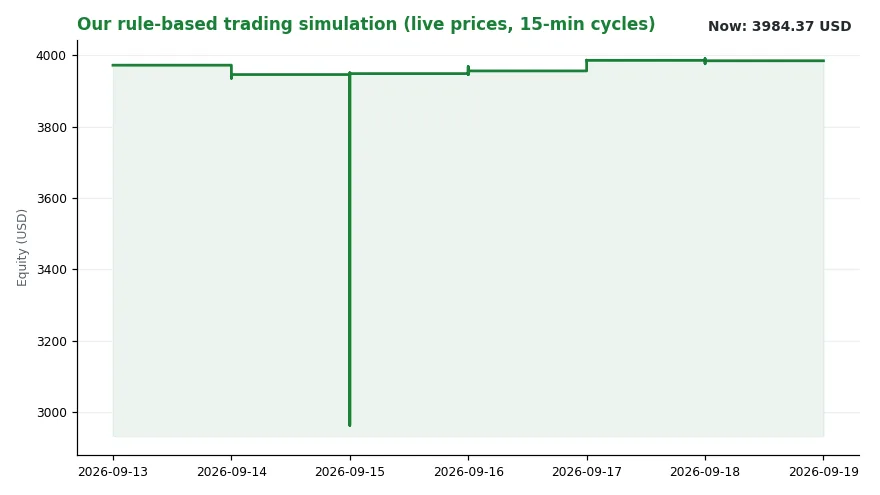
The last line in the rule-based trading log reads, verbatim: “Markt geschlossen — nur beobachten, nicht handeln.” Market closed, observe only, do not trade. A shut trading exchange, an honest note, no forecast dressed up as a decision. The note is a measurement, not a prophecy.
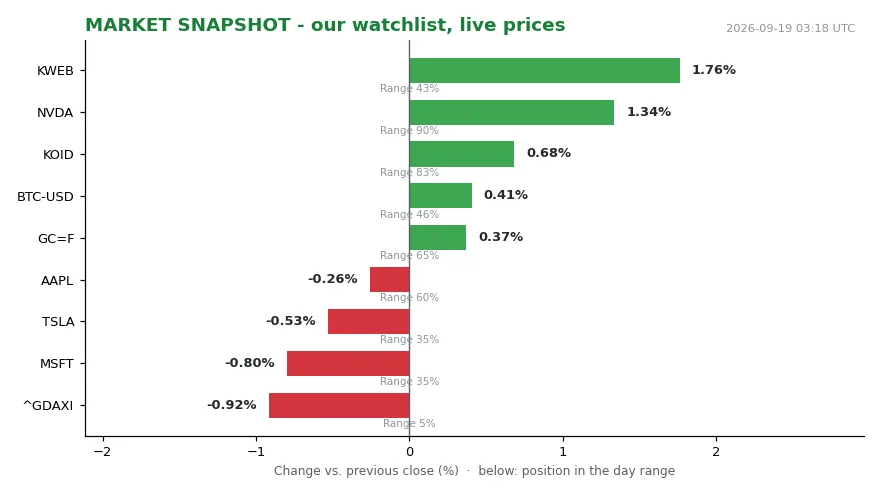
The readings below were pulled two minutes before writing. NVDA traded at 222.27, up 1.34 % from the previous close, and sat near the top of its daily high-low span — roughly 90 % of it. MSFT printed 493.78, down 0.80 %, and held the middle of its daily high-low span at 35 %. The German DAX index fell 0.92 % to 25304.06 and finished close to its low, at just 5 % of its daily high-low span. The China-internet ETF gained 1.76 % to 24.83. A thematic ETF added 0.68 % to 35.51, near the upper end at 83 % of its daily high-low span. Gold futures stood at 4415.90, Bitcoin at 81263.03. AAPL eased 0.26 %, TSLA eased 0.53 %. The market-state model labels the tape trend as falling at level 3.63. The paper-trading account balance sits at 3984.37 USD, unchanged over 24 hours, with 1987.26 USD in cash. The busiest signal channel on 2026-09-18 was central bank, with 2 events. The final logged decision was to watch the China-internet ETF and do nothing, for the honest reason that the trading exchange was closed.
The pattern is not flight. It is rotation. Semiconductors bid, very large-cap software offered, Europe near its lows, Chinese internet equities bid, gold and crypto mid-range. Money is changing seats rather than leaving the room. That distinction matters for the earnings map.
The Map
Zacks Investment
Research published a Q3 earnings preview. Its headline number: S&P 500 earnings are expected to rise 24 % from the same period a year earlier. [1] That would mark the eighth straight quarter of double-digit growth for the index. The firm describes momentum as broad-based, with 14 of its 16 sectors on track for positive earnings growth. [1] Only the conglomerates sector is expected to shrink, down 35.4 %. [1] The consumer staples sector should land roughly flat.
The earnings-revision river is the key image. For most of the past year, the river of analysts changing their profit forecasts ran through two narrow canyons — Technology first, then Energy, after Middle East supply disruptions pushed crude-linked estimates higher. A river with two channels is easy to monitor and easy to misread. What the Q3 2026 data show is a delta forming: the same current, now fanning into eight separate channels.
Those channels, per Zacks, are transportation, finance, aerospace, industrials, utilities and autos, alongside technology and energy. Analyst profit forecasts there have been rising. On the other side, eight sectors have seen estimates pressured since the quarter began: conglomerates, basic materials, consumer staples, consumer discretionary, medical, business services, retail and construction. Those two lists are the actual content of the preview.
One wrinkle deserves flagging. Basic Materials appears in both lists: listed among the sectors with downward profit-forecast changes, yet also among the five expected to post double-digit growth, at +31.2 %. The likely reconciliation is timing, since a strong full-quarter figure can coexist with a softening profit-forecast trend inside the quarter. The preview leaves it unresolved.
The growth list itself is striking. Aerospace leads at +159.3 %. Energy follows at +111.9 %. Technology comes in at +41.9 %. The basic materials sector is up +31.2 %, transportation +15.1 %. Five sectors in double digits, the remaining nine positive but slower.
Sensitivity is where a preview like this earns its keep. Remove Energy and S&P 500 growth falls from 24 % to 20 %. Remove Technology and what remains grows 14.4 %. Both figures still describe expansion. Neither is the headline figure.
The Mechanism
How does an earnings preview actually move anything? Two dials do the work. One is expected future cash flows, which profit-forecast changes affect. The other is the interest rate used to convert future cash flows into today’s value, which is where central banks live. The central bank channel is consistent with that mechanism. Upgrades change earnings expectations, rate expectations change valuation, and prices reflect both.
A third channel is physical rather than financial. Energy’s +111.9 % is tied in the source to Middle East supply disruptions, so it is a barrels story, not a multiples story. Supply shocks can reverse quickly, making that estimate the most reversible on the list.
The Actors
The winners and losers are already mapped; the question is who decides.
Who decides? Analysts, who revise. Central banks, which set the discount rate. Companies, which guide. And committee members who classify — because classification is an editorial act. A 16-sector grid is a choice, not a law of nature.
What We Watch Next
Three things. First, whether the count of sectors with rising profit forecasts stays at eight, widens, or narrows — the delta either spreads or closes. Second, watch the concentration math. Third, the central bank channel.
What we do not know should be said plainly. These are estimates, and estimates get revised again. The source presents them through charts. Estimates are rising even as the tape falls at level 3.63, and those two facts can coexist — one concerns expected cash flows, the other current positioning. Nothing above is a recommendation to buy or sell anything.
The core claim can be verified in about two minutes. Any sector earnings table shows how many sectors carry rising revisions. The baseline, from the source, is eight of sixteen. The count of sectors expected to grow at all is fourteen of sixteen, one shrinking, one flat. If the first count moves, the delta is opening or closing. If the second holds, the broad picture holds. That is the entire test.