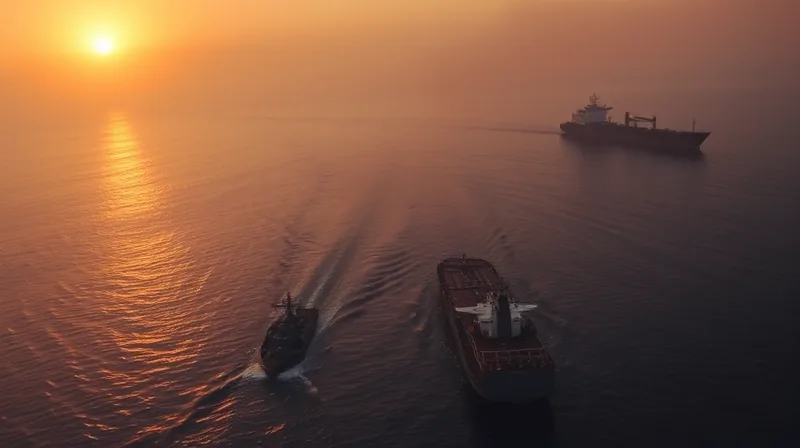
Oil Above 100 Dollars as Hormuz Conflict Dents Global Markets
The Tape Before the Headline
The first signal is on the tape. Nvidia traded at 223.67 dollars, down 0.91 percent, sitting at just 8 percent of its daily range — effectively at the lows The German blue-chip DAX stock index stood at 25,576.45, down 1.66 percent, also close to its day lows. The KWEB exchange-traded fund that tracks Chinese internet companies fell 2.29 percent to 24.78, at the very bottom of its range. Even gold, the classic refuge, lost 0.59 percent to 4,434.30 dollars and hugged its lows. The pattern is not rotation; it is compression. Stocks, commodities, cryptocurrencies, and other risky investments fall together, and safe-haven assets such as gold do not attract buyers. The trend reads as falling, with a signal level of 3.63. This is a market mood in which investors are selling risky assets and no safe-haven assets are being bought.
THE NEWS
The question is why everything sags at once. The answer sits under the Persian Gulf, and the news that moves it is brutal. UK petrol prices surged this week. The US-Israel war with Iran began on 28 February. Military strikes severely disrupted the production and transport of energy across the region. . When the US and Iran agreed a framework deal in June, prices fell. When the peace talks collapsed, they rose again. Brent crude, the global benchmark, is back above the 100-dollar mark. Simon Williams of the Royal Automobile Club (RAC), a motoring organisation, said there is “no sign of any relief yet” for drivers. [2]
From Strait to Pump
The path from strait to pump runs in steps. Crude oil is a key ingredient in petrol and diesel. Higher wholesale costs make filling a car more expensive. Demand and the ability of refineries to process crude oil into petrol and diesel also shape the price. The numbers at British pumps confirm the formula. Petrol now averages 167.17 pence per litre, its highest since the war began. Diesel sits at 188.63 pence. That is below its 15 April peak of 191.54 pence, but the direction is upward. In early July, petrol had fallen to 150.59 pence and diesel to 164.52 pence. Petrol just recorded its biggest weekly jump since April.
One Barrel in Five
About 20 percent of the world’s oil and liquefied natural gas normally passes through the Strait of Hormuz. That waterway carries one in every five barrels. . Before the war, Brent traded near 70 dollars a barrel. During the fighting it peaked above 120 dollars. After the framework deal in early July, it fell to near 70 dollars again. When talks collapsed, it climbed back above 100 dollars. It fell back for a few weeks, then a fresh escalation pushed it over the mark once more. The twenty percent is why the world cannot look away.
There is also a lag hidden inside those figures. Transporting oil is slow. Wholesale moves take about a fortnight to reach the pump.
Drivers, Retailers, Regulators
Drivers lose first. The RAC and the Automobile Association (AA) speak for them. Retailers face accusations of charging unfairly high prices. They deny it. The official markets regulator says it has “not seen evidence of retailers actively changing their pricing strategies to take advantage of the crisis.” The government scheme Fuel Finder lets drivers compare pump prices station by station. Luke Bosdet of the AA said his group had been surprised at how quickly prices fell earlier, and credited that transparency scheme. [3]
The Slow Burn
History offers a comparison, not comfort. In the summer of 2022, after Russia invaded Ukraine, petrol reached 191.5 pence a litre and diesel hit 199 pence. Today’s numbers remain below those records. Even if the strait reopens, normal shipping will take time to resume. The impact on the global economy could last months. The data shows the market already pricing that slow burn. When Brent sits above 100 dollars and equity indices fall toward their lows, geopolitics is visible in real time.
Who Is Watching
Knowledge is the one defence that is spreading. Fuel Finder exists because pump prices were opaque. The regulator watches because unfairly high prices were alleged. The RAC watches the wholesale-to-retail pipeline; the AA watches the speed of change. Yet knowledge can be misused in both directions. A retailer could use the crisis to raise margins. A politician could use the crisis to postpone hard decisions. A driver could use the news to hoard fuel. The regulator says it sees no evidence of the first. The second is visible: the duty rise was postponed to December. The third, hoarding, is the classic panic response that makes a supply problem worse. The regulator, the motoring groups, and the drivers on Fuel Finder are watching. But nobody watches the waterway itself except the navies at war. Williams’s phrase remains the honest summary: there is “no sign of any relief yet.
Sources
1. Nvidia
4. Forbes