The Instrument That Failed: A Diesel Tank, a Minimum Wage, and a Tape That Shrugged
This column rests on our own measurement — our daily tape, the instruments we track ourselves, read at 09:20 UTC on 2026-10-01. That morning the tape printed numbers that looked like a data error.
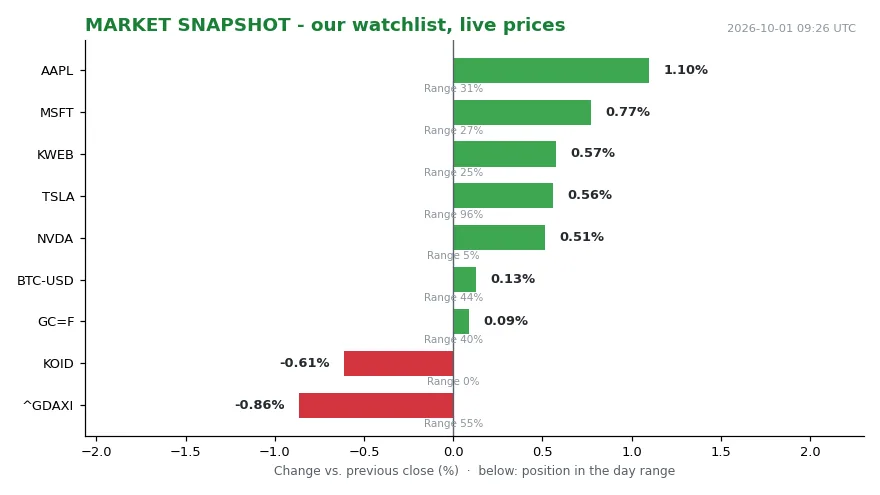
Nvidia stood at 228.38, up 0.51% on the previous close, pinned near day lows — about 5% of the distance between its daily low and high.
Tesla traded at 354.81, up 0.56%, pressed against the opposite edge at 96% of its daily range.
The DAX index sat at 24,957.71, down 0.96%, squarely in the middle of its daily range at 46%.
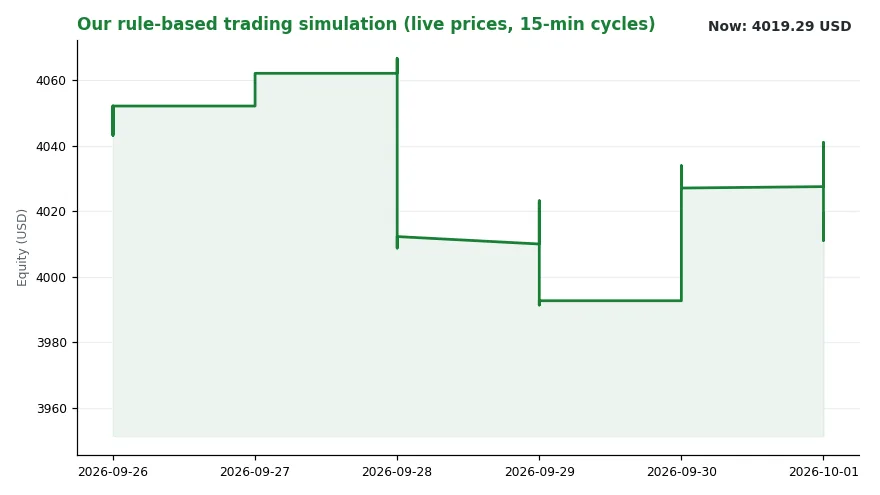
Our simulated portfolio showed 4,019.29 USD, down 0.19% against the same time yesterday.
Cash stood at 1,470.85 USD.
The last logged decision was to watch the KraneShares CSI China Internet ETF (KWEB) at 24.51, up 0.57% and mid-range.
The busiest internal news theme on 2026-09-30 was central banks, with two events.
Our composite market trend indicator came back with a falling trend and a level of 3.63.
Gold barely moved at 4,189.20, up 0.06%, mid-range.
Bitcoin traded at 83,684.73, up 0.14%, also mid-range.
The small fund was the only honest move: 35.73, down 0.61%, at the bottom of its daily range.
Two of the largest companies by market value at opposite extremes. One index in the middle. No direction anywhere.
The pattern is not rotation. It is a shrug.
We had assumed something else. Our working assumption was that the 39.6% diesel move the EU Weekly Oil Bulletin recorded would bend the market.
That assumption was wrong, and the error turned out to be the finding. Equities are a poor instrument for reading a fuel shock. The instrument that registers it is a household budget.
What the news actually says
A 50-litre diesel tank now costs the equivalent of 15.4% of Bulgaria’s monthly minimum wage before tax and social contributions. [1] The same tank costs 3.8% of Luxembourg’s monthly minimum wage before tax and social contributions.
Those two numbers are the story in miniature.
Before the Iran war began, the Bulgarian share was 9.9%. Diesel now takes 15.4% of that wage, up from 9.9% on 23 February.
The stated trigger is the Israeli-US attack on Iran, which effectively blocked the Strait of Hormuz, the narrow sea passage through which one-fifth of global oil passes. [1].
The EU Weekly Oil Bulletin recorded what followed. Between 23 February and 21 September, average EU consumer diesel prices rose 39.6%. Petrol rose 27.8% over the same window. [1].
Standard 95-octane unleaded petrol went from EUR 1.637 per litre to EUR 2.092. Diesel went from EUR 1.594 to EUR 2.226.
The expectation embedded in those numbers is a new line item, not a spike. Equity markets have not repriced it as a systemic event. Households have already repriced it as a monthly one.
The channel runs through the wage share
The transmission channel here is not interest rates. It is the share of a wage.
Torsten Müller, senior researcher at the European Trade Union Institute, explained the asymmetry. [1].
Low-income households, he noted, spend a larger proportion of their income on essentials such as housing, food and transport than high-income households. [1] That is the mechanism in a single line. Essentials cannot be deferred. Rent, commuting and food all fall due.
Müller also noted that the gap between countries is mostly a minimum-wage gap, not a fuel-price gap.
One litre of diesel, he added, is only marginally cheaper in Bulgaria, while the minimum wage there is less than a fourth of Luxembourg’s. [1] He added that the difference survives adjustment for cross-country price differences: on purchasing power standards, which correct for price levels, Luxembourg’s minimum wage is still twice Bulgaria’s.
The litre price converges across Europe. The ability to pay does not. That asymmetry is what the data keeps returning.
The numbers, country by country
For petrol, the share of a monthly minimum wage needed for a 50-litre tank ran from 3.3% in Luxembourg to 13.4% in Bulgaria, as of 21 September. [1].
Above 10% were Latvia at 12.8%, Turkey and Romania at 11.5% each. Greece and Czechia followed at 10.2%, then Estonia and Slovakia at 10.1%.
Below 5% were Ireland at 4.1% and Belgium at 4.4%. Germany, among the major economies, was lowest at 5.0%.
Diesel runs heavier where it costs more per litre than petrol.
For diesel, the range was 3.8% in Luxembourg to 15.4% in Bulgaria.
Above 10% were Latvia at 13.9%, Turkey at 13.8% and Romania at 12.7%. Czechia and Estonia followed at 11.2% each. Then Hungary at 10.8%, Greece at 10.4% and Portugal at 10.3%.
Lowest for diesel were Ireland at 4.3%, Germany at 5.2% and Belgium at 5.3%. The Netherlands followed at 5.5%.
Who carries it, who decides
The losers are named with unusual precision. Minimum-wage earners in Central and Eastern Europe carry the heaviest share.
A monthly minimum wage buys 324 litres of diesel in Bulgaria. The same wage buys 1,311 litres in Luxembourg. Roughly a fourfold gap separates them. [1].
Esther Lynch, general secretary of the European Trade Union Confederation, described where that arithmetic breaks: when the average cost of rent is already more than a third of the minimum wage, spending another 15% of an entire wage on fuel is not possible, she said - and warned that people would be forced to give up their jobs, especially where there is no reliable public transport. [1].
The deciders sit somewhere else entirely. Minimum wages are set nationally, not centrally. Over this window, most of them did not move.
Estonia posted the largest eurozone increase, 6.8%, between the first and second halves of 2026. Malta was the only country in the comparison where fuel prices stayed unchanged.
The comparison covers 22 EU countries plus Turkey, an EU candidate country, and uses monthly minimum wages before tax and social security deductions. [1].
Measured against take-home pay, every one of those percentages would be heavier still.
What we watch next
Three things to watch, and one honest caveat.
The EU Weekly Oil Bulletin is the next reading: it tells us whether the 39.6% diesel move is a plateau or a slope.
National minimum-wage rounds matter next: if wages stay flat in the countries where shares are highest, the pressure compounds quietly.
The Strait of Hormuz is the third variable: a durable reopening would unwind part of the mechanism, a prolonged closure would deepen it.
The caveat is real. We have two snapshots, 23 February and 21 September. Snapshots are not trends. Whether households cut driving, cut food or leave jobs is not visible yet.
Our own tape adds a second caveat. The regime reading is trend=falling at 3.63, yet nothing on the watchlist screams fuel emergency. That could mean the market expects a short disruption, or that it is holding the same wrong instrument we did. From one morning of quotes, we cannot tell which.
What we can say is that the pain is measured, published and uneven. The unevenness is structural, not accidental. Müller’s point holds: the minimum wage, not the litre price, does the work.
A minimum wage in Bulgaria buys 324 litres of diesel. A minimum wage in Luxembourg buys 1,311 litres. Same fuel. Same month. Same continent. One tank costs 15.4% of the first wage. The same tank costs 3.8% of the second.
Our tape reads the shock as a shrug; the wage share reads it as a squeeze. Same event, two instruments — and only one of them is the one that gets paid.
This is educational analysis, not investment advice.