
The Broken Instrument Was Right: Japan’s 31-Year High and the End of Cheap Mon
ey
The dashboard read the trend as falling, and the initial instinct was that the instrument had failed.
That instinct was wrong, and the correction is the whole story.
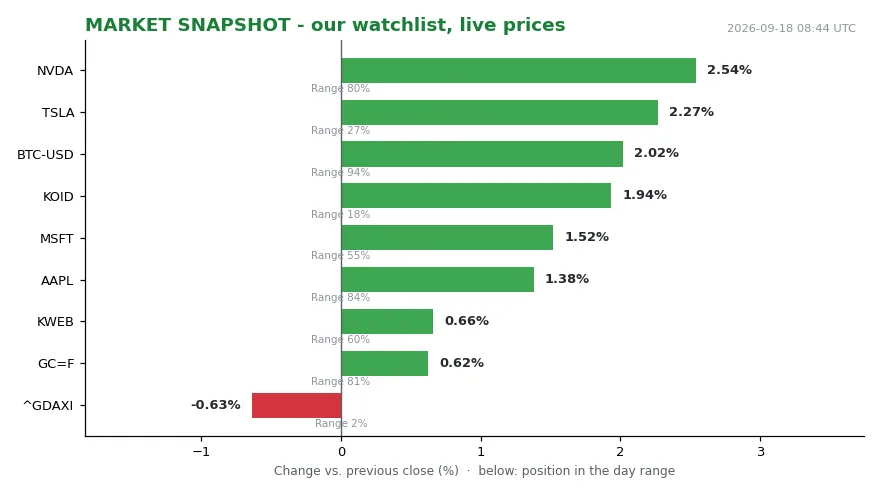
The continuous feed of live market prices at 08:40 UTC on 2026-09-18 showed the following:. Nvidia traded at 219.34, up 2.54%, near the highest price of the session, at 80% of the distance between the session low and high. [1] Apple traded at 337.00, up 1.38%, even closer to the highest price of the session, at 84% of the distance between the session low and high. [2] Bitcoin stood at 77849.63, up 1.96%, near the highest price of the session, at 92% of the distance between the session low and high. Gold futures held 4428.00, up 0.64%, near the highest price of the session, at 83% of the distance between the session low and high. Those four readings all point the same direction.
Then the counter-evidence arrives. Germany’s DAX index sat at 25559.96, down 0.61%, near the lowest price of the session, at just 5% of the distance between the session low and high. The KraneShares Global Carbon Offset Strategy ETF (KOID) was up 1.94% at 35.27 yet still pinned near the lowest price of the session, at 18% of the distance between the session low and high. [3] Microsoft rested at 55% of the distance between the session low and high, Tesla at 27%, and the KraneShares CSI China Internet ETF (KWEB) at 60%. [4]
This is not a broken instrument. This is rotation, and it is happening while the market-regime model reads trend=falling at level 3.63. The channel that fired most often on 2026-09-17 was ‘central bank’, with 3 events.
US technology and crypto near their highs, European and thematic exposure near their lows, and central banks as the loudest signal. That combination is precisely what the Bank of Japan delivered on Friday.
The Rate That Ended an Era
Japan’s central bank raised its main interest rate from 1 % to 1.25 %. [6] That is a level not seen since 1995 — a 31-year high. [6] The move was widely expected. What is not routine is the direction of travel: six hikes in roughly two and a half years, launched from minus 0.1% in 2024. [6] That starting point is the real story, not the destination.
The Energy Problem Behind the Rate
A physicist would look at Japan and see an energy problem before a money problem. Global oil and gas prices have risen this year because the Iran war caused major disruptions to shipments through the Strait of Hormuz. Japan is heavily reliant on energy from the Middle East, so a supply shock travels into its economy with almost no friction. Raise the price of the input, and downstream prices can eventually follow. Interest rates cannot drill a barrel or reopen a shipping lane.
The Workforce That No Rate Can Enlarge
A biologist would look at the same country and see a shrinking workforce. Fewer workers against steady demand can mean less output per head, and it can create wage pressure that has little to do with monetary policy. Demography does not answer to a policy rate. It answers to time, and Japan has been spending that particular currency for decades.
The Yen at a 40-Year Low
An economist would point at the yen. In August, Tokyo and Washington confirmed that they had jointly intervened — buying or selling currency together to move its price — to halt a slide in the currency after it fell to a fresh 40-year low. [7] That coordinated action was the first of its kind since 2011, when the two countries moved together to weaken the yen after the earthquake and tsunami that hit eastern Japan. [7] Note the inversion: back then the goal was a softer currency, and now the goal is a firmer one. Both Japan’s Ministry of Finance and US Treasury Secretary Scott Bessent said at the time that they would not hesitate to conduct more joint currency interventions, where two governments act together to move the exchange rate. [8]
How the Loop Is Supposed to Work
Follow the channel, because it is narrower than it looks. When a central bank raises interest rates to reduce inflation, the currency usually strengthens, since holding it becomes more attractive to traders. A stronger yen can make imported energy cheaper, which may ease the very inflation the hike was meant to fight. That loop is the intended design, and it is slow. It also runs in reverse. If the yen stays weak even after rates rise, the imported inflation simply persists, and the policy loses its grip.
Lale Akoner of eToro framed that risk without decoration, warning that a weak yen alongside higher rates could push inflation pressure to the point where the BOJ tightens faster than markets or the Japanese government would like. [9] Her other line deserves to be pinned above a desk: one of the world’s last sources of ultra-cheap money is disappearing. [9]
Three Central Banks, One Driver
Japan is not tightening into a vacuum. The US Federal Reserve raised its benchmark policy interest rate on Wednesday, its first increase in over three years. The European Central Bank increased borrowing costs earlier this month. Three major central banks, one shared driver: higher energy prices helping to push inflation up. When the world’s largest monetary authorities move in the same direction at the same time, the combined effect may be larger than the sum of the individual moves.
The inflation data underneath the decision is subtler than the headline. Official figures published on Friday, ahead of the BOJ announcement, showed core inflation — which excludes volatile food and energy prices — easing to 1.7% in August from 1.8% the previous month. [10] That remains close to the bank’s 2% target. Judged internationally, 1.7% is unremarkable. Judged against Japan’s own history, it is remarkable, because this economy spent roughly three decades in low inflation or outright deflation — a sustained fall in the general price level — and rising prices are a relatively new development there.
The Distribution of Pain and Gain
The distribution is legible in the debt. Borrowers who built business models on near-zero funding now face a cost of capital — the rate a business pays to fund itself — that a generation of managers never had to model. Deposit-taking institutions and savers may get something back after years of earning nothing. Exporters may receive a currency tailwind that can act as a demand headwind, depending on where their customers sit. The legal decision rests with the BOJ and its Governor, Kazuo Ueda, who is being pushed from Washington as much as from Tokyo. Bessent has publicly urged Ueda to “do the right thing”. [8] That is pressure rather than authority, but in currency markets the distinction is often academic.
The One Variable That Matters
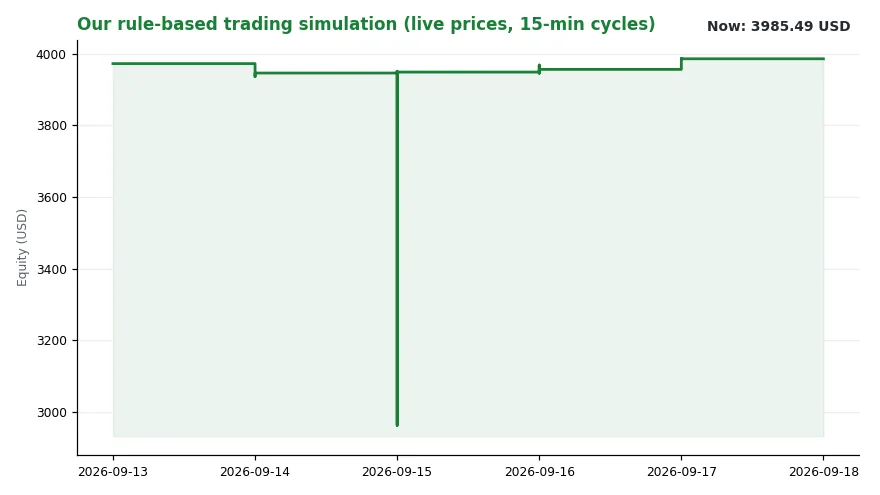
The variable to track is the yen’s response to the rate level. The tape leaves that question open: the falling regime and the near-high readings have not resolved into a single direction. The book was unchanged overnight, and the sim portfolio’s record shows restraint, not a forecast.
The uncertainty is genuine. The path ahead depends on energy prices Japan does not control, on intervention decisions two governments make jointly, and on a workforce no rate can enlarge.
The good news is that the mechanism is fully visible. Core inflation eased to 1.7%, and the transmission channel from energy prices to policy rates to the currency is legible to anyone willing to read it.
The bad news is that the pressure was already here. It was in the minus 0.1% that Japan carried into 2024. It was in three decades of deflation that made yen funding a global habit. [10] It was in the sixth hike, in the 31-year high, and in the 40-year low for the currency that came first.
Cheap money did not leave Japan this week. It left slowly, over years, and this week it simply became impossible to ignore.
Sources
1. Nvidia
2. Apple
3. KraneShares
4. Microsoft
5. Tesla
8. US Treasury
9. eToro