India Toy Tariff Worked Yet China Deficit Hit 112bn
Meta commentary - no external expert source; basis: Feeds.bbci.co.uk (2026-10-05). #MetaEconPol
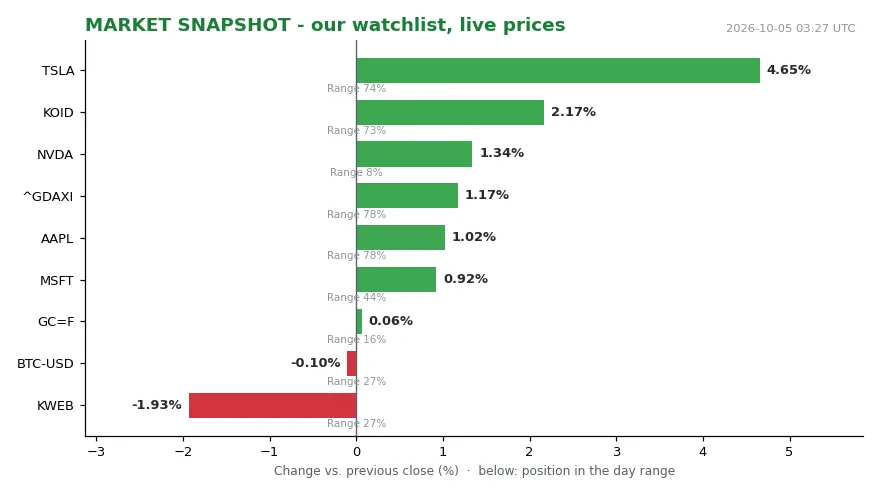
Our latest measurement, as of 2026-10-05 03:22 UTC, shows a market splitting in two directions at once. Nvidia trades at 233.95, up 1.34%, but pinned near the day’s lows — only 8% of its range sits behind it. Apple trades at 333.69, up 1.02%, and it holds near the day’s highs, with 78% of its range used. The DAX shows the same shape: 25231.20, up 1.17%, also near its high. Microsoft is at 517.53, up 0.92%, mid-range at 44%. Tesla is the day’s mover at 370.59, up 4.65%, mid-range at 74%.
Now look at what is not participating. Bitcoin is at 86333.49, down 0.21%, near its low at 15% of range. Gold is at 4165.80, up 0.08%, also near its low, at 19% of range. And the China internet basket KWEB is the only line moving lower with conviction: 23.86, down 1.93%, mid-range at 27%.
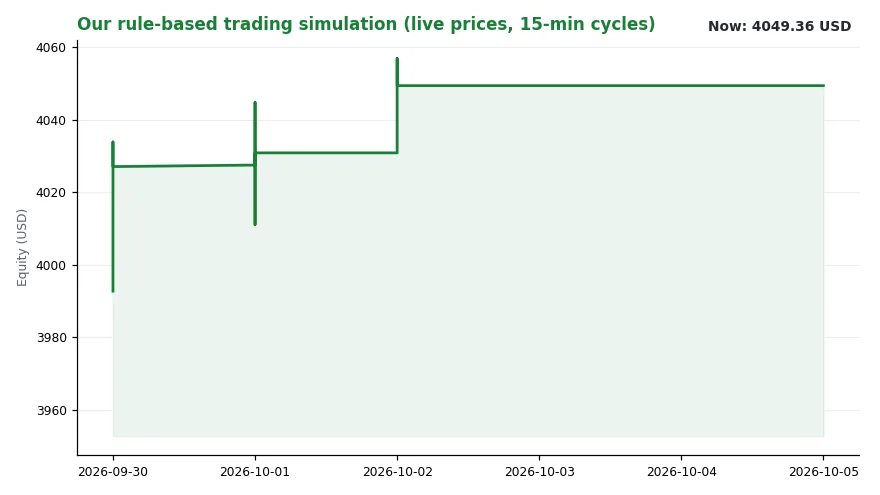
Our reading of that pattern is a rotation into developed-market equity risk, while China-facing exposure gets quietly marked down and the classic hedges sit idle. Our rule-based simulation stands at 4049.36 USD, flat against the same time yesterday, holding 2020.64 USD in cash. The most recent simulation decision was to watch KWEB at 0.00, not to trade it. The busiest signal channel on 2026-10-04 was central banks, with a single event. Our regime reading is trend=falling, level=3.63.
Why a toy shop is the news
The mechanism was blunt. Six years ago Delhi raised tariffs on imported toys from 20% to 60%, and eventually to 70%. Retailers objected loudly, arguing that domestic firms could never match foreign-made goods. Higher customs duties combined with quality-control standards did the work anyway. Indian toy imports fell by a third, from nearly $300mn in 2020 to $100mn this year. Exports rose from around $129mn to $200mn over the same period. And the country was able to drastically reduce its dependence on China, which held a 70% share of the local toy market.
Then the wider picture. Diplomatic ties broke down after the Galwan Valley clashes in 2020, and Delhi announced anti-dumping duties and a ban on Chinese apps including TikTok. India’s trade deficit with Beijing went the other way regardless, from $44bn in 2020 to $112bn this year. Exports to China stayed below pre-pandemic levels even as imports doubled.
The analyst Kevin Zongzhe Li of the Asia Society Policy Institute’s Centre for China Analysis: “India’s economic dependence on China continued to deepen while political, security, and investment ties were at their lowest point.” [1] Ajay Srivastava of the Delhi-based Global Trade and Research Initiative (GTRI) says: “China now supplies over 30% of India’s industrial imports, and India depends on it for more than 100 critical products. And the imbalance is worsening.” [1] Should the import pace continue, Srivastava calculates the bilateral deficit could reach $134bn, handing Beijing even more leverage over Indian industry.
The channel: from finished goods to inputs
Srivastava: “Yet, production remains largely assembly-based and depends heavily on imported components, particularly from China.” The same pattern runs through industrial machinery, battery inputs, chemicals, solar cells and manufacturing equipment. Electrical machinery and electronics alone account for 36% of imports, followed by machinery and mechanical appliances at 21.7%, according to the Observer Research Foundation.
Soumya Bhowmik, a fellow at ORF’s Centre for New Economic Diplomacy, argues that this reflects India’s difficulty in substituting Chinese inputs with local production: “Their interruption would not merely affect consumption; it would disrupt production itself.” [1] Two macroeconomic currents push in the same direction. China carries huge excess capacity in sectors from steel to solar panels and electric vehicles, while its slowing economy cannot absorb the output, so manufacturers sell cheaply into overseas markets. China’s trade surplus is expected to top $1tn for a second straight year. On the other side, Western markets impose tariffs and other restrictions, pushing more of that output toward Indian shores.
Who wins, who loses, who decides
Indian toy manufacturers are the visible winners of the tariff round. Retailers, who warned that domestic firms could never match foreign-made goods, lost that argument. Indian assemblers sit in between, winning orders while losing leverage, because their components arrive by ship.
The deciders are Delhi and Beijing. On the sidelines of the Brics summit in Delhi in September, Prime Minister Narendra Modi and Chinese President Xi Jinping vowed to address “structural trade imbalances and supply chain issues”.
Access is the sticking point on the other side of the ledger. Li: “Indian products face a variety of tariff and non-tariff hurdles in China that make it difficult to scale exports.” And: “If normalisation [of ties] continues without a serious push for reciprocal market access, India risks a situation where the political relationship improves but the economic dependency stays the same.”
What to watch next
Three things, with honest uncertainty attached to each.
First, whether market access actually moves. Li points to pharmaceuticals as a natural fit, given China’s aging population and rising healthcare costs. He also tempers the idea: “But narrowing a $112 billion deficit won’t come from finding niche export sectors alone.” The question he poses is “whether Beijing is ready and willing to make concessions on market access as part of the broader normalisation.” Second, foreign direct investment. India has recently softened FDI rules, which could open the door to Chinese companies expanding Indian investments. Srivastava’s test for approvals is explicit: “Investment that merely expands distribution networks or assembles products using Chinese parts could increase imports and deepen dependence. Approvals should therefore prioritise technology transfer, local value addition, domestic component production and exports from India.” Third, the fundamentals. Strengthening manufacturing requires affordable power and credit, efficient logistics and stable regulations. On those fronts, India still falls short. **What this means for the shelf. The toy on the shelf is the easy case, and it is largely solved. The charger, the battery, the circuit board, the machine that made the toy — those are the hard case, and they are not.
That is why a toy shop works as a barometer. It shows what tariff policy can do when the product is simple, and what it cannot do when the product is a component.
Our own tape says something similar in prices. Apple near its high, the DAX near its high, and KWEB — the China exposure — the one line in the red. The market is not pricing a rupture. It is pricing a slow, quiet dependence. Our simulation holds 2020.64 USD in cash and a flat 4049.36 USD in equity, watching KWEB rather than trading it. That is an honest position on an imbalance with no visible exit date. The toy shop is the solved case. The component is the open one.
Sources
Mentioned organisations (context, not sources)
- Nvidia — Organisation (homepage)
- Apple — Organisation (homepage)
- Microsoft — Organisation (homepage)
- Tesla — Organisation (homepage)
- TikTok — Organisation (homepage)
- Asia Society Policy Institute — Organisation
- Centre for China Analysis — Organisation
- ORF — Organisation (homepage)
- BRICS — Organisation (homepage)