
Harvard’s Best Year in Five Years, and the Tax Bill That Rises With It
The endowment returned 27.1 % on SpaceX and AI bets. That same result also lifts the base for a federal excise tax that is about to multiply.
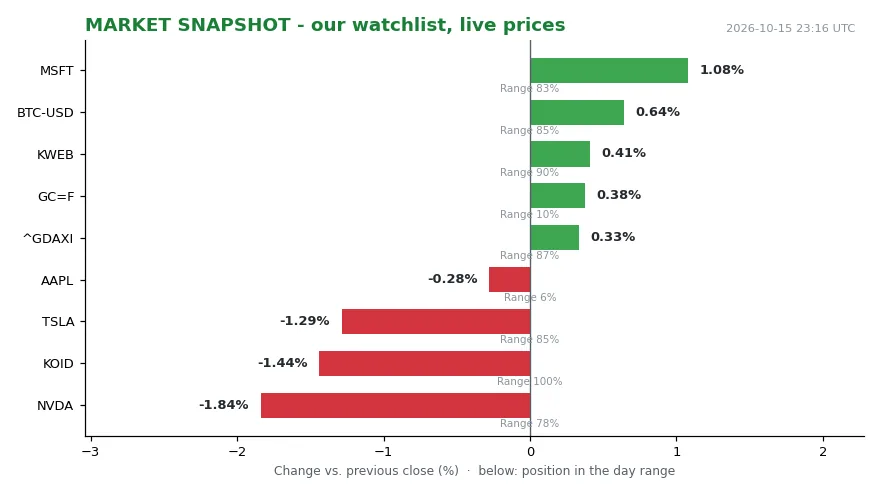
Start with the tape we read every day. Nvidia closed at 217.23, down 1.84 %. It finished at 78 % of its intraday range. Microsoft closed at 539.44, up 1.08 %, at 83 % of its range. Apple closed at 342.00, down 0.28 %, at 6 % of its range, near the day’s low. Bitcoin traded at 82,266.46, up 0.85 %. That is 91 % through its range. Gold sat at 4,186.40, near the bottom of its band. The DAX stood at 25,382.62, up 0.33 %, close to its high. KWEB printed 24.61, up 0.41 %, 90 % through its range. KOID printed 32.87, down 1.44 %, at its range high.
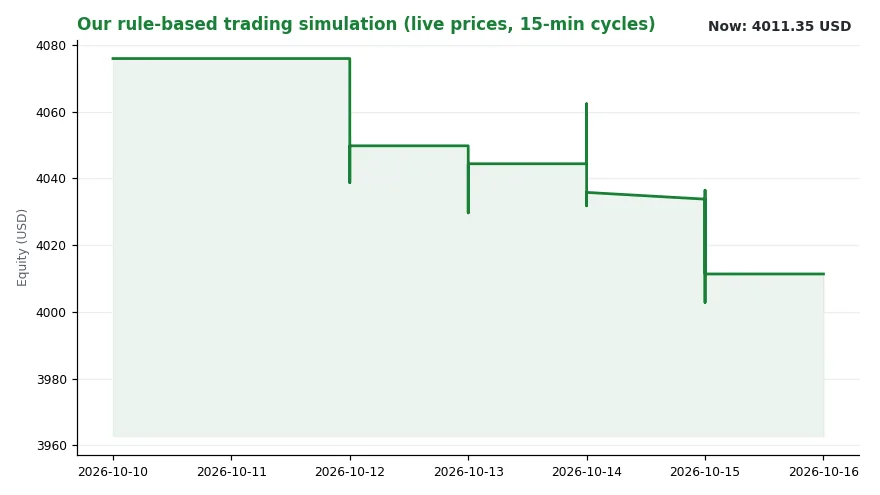
Read the pattern. This is rotation, not retreat. Money is not leaving risk. It is moving inside the risk complex. Out of one megacap, into another. Out of gold, into crypto and equities. Our rule-based book reflects the pause. Sim equity stands at 4,011.35 USD, flat against the same time yesterday. Cash is 2,014.07. The latest decision was WATCH KWEB. The regime reading is trend falling, level 3.63. The busiest signal channel on 2026-10-15 was central banks, with two events.
Now change the clock. That tape is measured in minutes. A university endowment is measured in fiscal years, and spent across decades. Harvard’s fiscal year closed on June 30. The result was 27.1 %, according to the university’s annual financial report. It is the strongest return in five years. The figure beat the S&P 500’s 22.3 % total return over the same period by 4.8 percentage points. The pool now totals nearly $68 billion. That is up about $11 billion from the prior year. The median large endowment returned roughly 18.9 %. Harvard finished more than eight percentage points ahead of that mark. The underlying document is the FY 26 % financial report. It runs 49 pages and was released on a Thursday.
The catalyst has a date. SpaceX went public in June 2026, days before the fiscal year closed. The offering became the largest IPO in history. The company was valued above $1.8 trillion after its debut. Harvard’s 13F filing with the SEC, disclosed in August 2026, showed a $2.2 billion stake in the rocket and satellite company. That position was more than half of HMC’s $4.3 billion US equities portfolio. It is the endowment’s largest single holding by value. Taiwan Semiconductor came next, at just under $350 million. The AI build-out supplied the rest. HMC established a position worth roughly $239 million in Cerebras Systems, the AI chipmaker. It significantly increased its holdings in Nvidia and Taiwan Semiconductor. Nvidia designs the chips; Taiwan Semiconductor manufactures a large share of them. HMC chief executive N.P. “Narv” Narvekar attributed the year to three engines — venture capital, public equities and hedge funds. Over his nine years at the helm, the endowment has delivered an 11.4 % annualized return. Private equity previously accounted for nearly half of Harvard’s holdings, alongside venture capital, hedge funds and public stocks.
That is the return side. The transmission side is slower and more deliberate. In the 49-page report, Harvard’s chief financial officer Ritu Kalra and treasurer Timothy Barakett wrote: “While markets can easily take back what they give, that return will strengthen the endowment’s capacity to support the University over time.” [1] They added: “The University deliberately smooths distributions so that operating support does not rise and fall with the markets. Strong investment returns therefore support Harvard’s work gradually, through future distributions.” [1].” So the mechanism is a smoothing rule, not a spending switch. A 27.1 % year does not arrive on campus as a 27.1 % budget increase. It arrives as a slower, steadier distribution stream. That is the design. It cuts both ways. It shields the operating budget from a bad year. It also delays the benefit of a good one.
Then the constraint arrives. Kalra and Barakett wrote that “endowment resources will face an additional constraint, with the federal excise tax on Harvard’s net investment income rising nearly six-fold, from 1.4% to 8%.” [1] The same passage states: “We estimate the higher rate will cost roughly $300 million a year.” [1] The report is blunt about the interaction with performance. In its words: “[I]n a year of returns like this one,” the federal excise tax “would be several times larger.” [1].”
Here is the hinge. A celebrated return and a levied tax are computed on the same base. The stronger the year, the larger the charge. That is not a forecast. It is arithmetic the university put in writing.
The rest of the ledger carries its own pressure. Federally sponsored research revenue declined 19.5 % to $509 million in fiscal 2026. Investment returns were not the only support. Harvard reported a record $1.5 billion in donations. Of that, $684 million came as current-use gifts — money the university can spend now rather than invest for future income. It also posted an operating surplus of $100 million. It managed that even as federal research revenue fell.
The actors are visible. HMC manages the money, and Narvekar runs HMC. Kalra and Barakett signed the financial narrative. President Alan Garber struck a forward tone: “Together, we have the opportunity to set the University on a path to excellence that none of us can imagine today.” He added: “Notwithstanding the challenges and uncertainty, this is a thrilling time to be part of a great American institution devoted to Veritas.” On the other side sits the federal government. The filing lands against a backdrop of federal pressure. The Trump administration has moved to penalize the school and withhold funding from it, including a suit alleging a failure to protect Jewish students and another accusing Harvard of defying an admissions probe. One headline in the same coverage reads: “Trump says Harvard to pay $500 million in deal with administration.” Winners and losers are not symmetrical. SpaceX and the AI supply chain delivered the returns. Donors delivered the gifts. The endowment and the donor base now carry more of the load as federal research money declines. And the concentration behind the headline is also the exposure. A single holding accounted for more than half of a $4.3 billion equity book. SpaceX now trades publicly, so that stake is marked to market every day. Private holdings are revalued only periodically. Public ones move with every headline, every earnings call, every shift in mood.
What we watch next is specific. First, the excise tax math: 1.4 % to 8 % on net investment income, against an estimated $300 million a year. Second, whether federally sponsored research revenue stabilizes after a 19.5 % decline. Third, the daily mark on the SpaceX position, now visible in public prices rather than appraisal cycles. Fourth, whether peers narrow the gap. An 18.9 % median is a reminder that 27.1 % is a spread, not a norm. We hold all of this as observation, not advice.
The unintended consequence is plain. Harvard’s strongest year since 2021 also built the largest base for a tax that begins in the current fiscal year. The market gave, and it can take back — the report says as much. The tax base does not wait for the next drawdown. Success enlarged it. [1].
Sources
Mentioned organisations (context, not sources)
- Harvard University — Organisation (homepage)
- Harvard Management Company — Organisation (homepage)
- U.S. Securities and Exchange Commission — Organisation (homepage)
- SpaceX — Organisation (homepage)
- Nvidia — Organisation (homepage)
- Apple — Organisation (homepage)
- Taiwan Semiconductor — Organisation (homepage)
- Cerebras Systems — Organisation (homepage)