
Gold at Ceiling DAX on Floor After Fed Hike
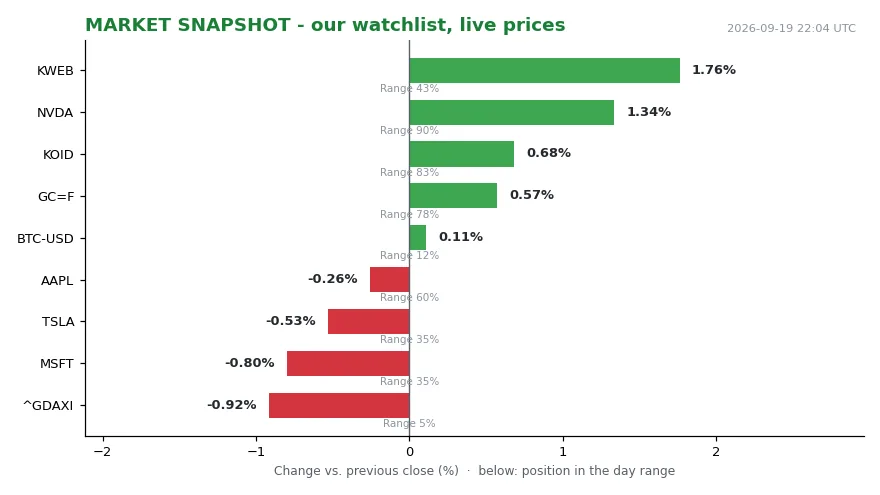
Two assets moved in opposite directions on the same policy statement. Gold futures (GC=F) print 4,424.90, up 0.57 % and parked at 78 % of the day’s range — near the ceiling. The German DAX (^GDAXI) prints 25,304.06, down 0.92 % and at just 5 % of its range — flat on the floor. Nvidia (NVDA) trades at 222.27, up 1.34 %, at 90 % of its range, while Bitcoin (BTC-USD) holds 81,063.73, up 0.23 % but at only 22 % of its range, near the day’s low. One policy statement out of Washington reached all four of them. They did not answer it the same way.
The divergence points to rotation rather than retreat. US mega-caps split down the middle — Apple (AAPL) at 336.13, off 0.26 % and mid-range at 60 %, against Microsoft (MSFT) at 493.78, down 0.80 % at 35 % of its range, and Tesla (TSLA) at 364.27, off 0.53 % at 35 %. The China internet proxy KWEB is the strongest line on the board, up 1.76 % at 24.83, though it also sits mid-range at 43 %. The KOID line adds 0.68 % to 35.51, at 83 % of its range. Read together, the assets that carry their own story — AI capital spending, gold as a monetary hedge, a China re-rating — are holding their ground. The assets priced off the discount curve look tired.
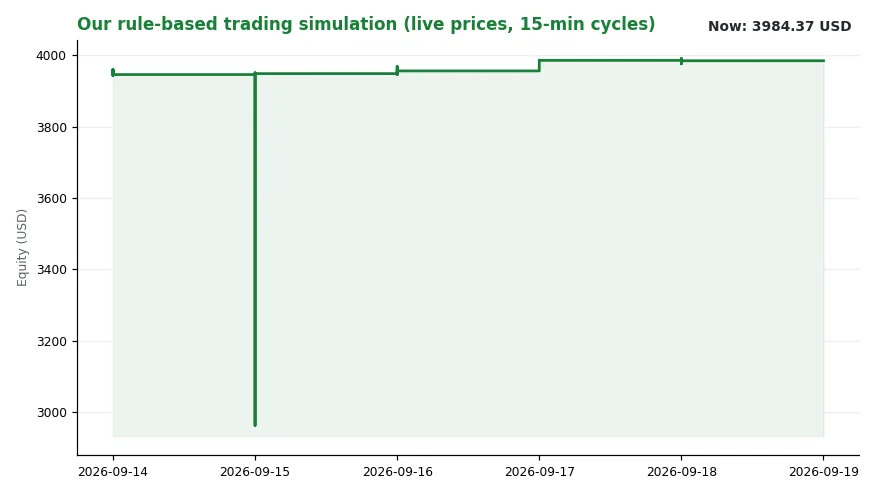
The simulated book reflects the same split. Sim-Equity stands at 3,984.37 USD, +0.00 % against the same time a day earlier, with 2,002.35 USD in cash — roughly half the account uninvested. The last logged decision was BEOBACHTUNG KWEB @ 0.00 at 2026-09-19 21:54:23.
Now the map. The Federal Reserve raised interest rates by 0.25 %, the first increase in three years, in a unanimous 12-0 vote. [5] The target range moves from 3.5 %-3.75 % to 3.75 %-4 %, according to the agency. [6] In its statement, the Fed said economic activity is expanding at a solid pace, that uncertainty remains elevated owing in part to geopolitical developments, and that domestic spending has been resilient. It pointed to strong productivity growth and robust capital investment, noted that job gains have kept pace with the workforce, and observed that the unemployment rate has changed little. Inflation, the committee noted, remains high — but the decision, in its words, “will support a timelier return to the Committee’s 2 % goal.” [6] Chair Kevin Warsh framed the move around two mandates: stabilizing prices and supporting full employment. “Our decision comes at a time when the American economy appears to be strengthening,” he said, adding that he would be hard pressed to describe broad financial conditions as restrictive. [6] He also noted that unemployment remains low while inflation has stayed high for more than five years.
The decision itself is the story. The committee had held its policy rate steady for three years before this move. Inflation above target for more than five years is the scoreboard that closed that chapter. Unanimity, 12-0, is the other half of the story.
History offers a rough template. The long pause that ended with the 2015 liftoff is a reminder that first hikes in a new cycle have usually mattered less for what they did to prices that week than for what they did to expectations. The quarter point is arithmetic. The break in the pattern is the message.
Gold is the test case. Gold sits near its session high. That is either a hedge being paid for, or a market that doubts the tightening stops here.
Cash holders earn more, and the sim’s 2,002.35 USD is a small illustration. Borrowers with floating-rate exposure carry the other side, as do long-duration equities and rate-sensitive industrials — the DAX, closing at 5 % of its range, is the clearest example on our board. The twelve voters decided unanimously. Equity markets are voting by sector instead of by index: semis and gold firm, mega-cap software soft, Bitcoin near its low, China internet bid. KWEB’s 1.76 % gain and NVDA’s close at 90 % of range are neither agreement with the Fed nor rejection of it. They are different answers to the same discount-rate question.
What matters next is confirmation or contradiction. Whether gold keeps climbing while the policy rate climbs will strain the simple “rates up, gold down” story. Whether the DAX’s weak close stays a German story or spreads into the wider European tape is the next question. KWEB, the strongest line measured, needs to show staying power rather than a single session. The next statement’s language will show how the committee defines “restrictive” in practice. The front end of the curve, the dollar, and credit spreads will carry the next signal.
That leaves an open question. If a target range of 3.75 % to 4 % does not feel restrictive to the person setting it, then the number that matters most is the one nobody can observe directly — the neutral rate. Where it sits, and whether the economy has moved it, is now the question the next several meetings will quietly be organized around. The tape does not answer it. It only shows who is already positioning for one answer or the other, near the ceiling on one side of the Atlantic and on the floor on the other.
Sources
1. Nvidia — Organisation (homepage)
2. Apple — Organisation (homepage)
3. Microsoft — Organisation (homepage)
4. Tesla — Organisation (homepage)