
Deficits and AI Borrowing Push 10 Year Yields Higher
Meta commentary - no external expert source; basis: Cnbc (2026-09-26). #MetaEconPol
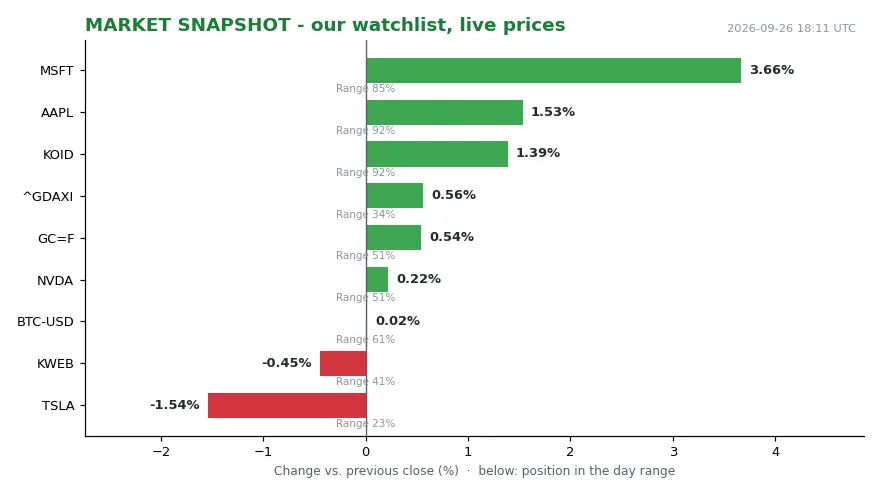
MSFT traded at 516.17, up 3.66 % and near day highs (85 % of its range). AAPL stood at 341.07, up 1.53 % and near the top of its range (92 %). TSLA moved the other way, at 372.11, down 1.54 % and close to day lows (23 %). NVDA was nearly flat at 225.07, up 0.22 % and mid-range (51 %). Gold at 4321.20 (+0.54 %, mid-range) and bitcoin at 84130.53 (+0.06 %, 68 % of range) sat still. That is a rotation inside equities, not a flight out of them.
The story is sticky inflation, a Federal Reserve that will have to tighten again, and a bond market repricing that reality. That story is not false, but it is incomplete.
The key 10-year Treasury yield — the rate that influences mortgages and anchors much of the world’s borrowing — leapt to 5.23 % on Friday. Earlier this month, the same benchmark was trading just below 4.8 %. Yields and bond prices move inversely, so that climb is a price decline across a vast stock of outstanding debt. Behind the move sits a real shift in expectations. Fed funds futures trading implies a 64 % likelihood of a rate hike in October, according to the CME FedWatch tool. The University of Michigan’s consumer sentiment index showed year-ahead inflation expectations leaping to 4.6 % in September, up from 4 % in August and the highest reading since June. An investor holding a fixed coupon while expectations run at 4.6 % is losing ground, and that is one reason yields rise to compensate.
But expectations alone do not explain the size of the move. Thierry Wizman, global FX and rates strategist at Macquarie Group, told CNBC that the driver this year is different. “I think this year it has more to do with the bond issuance than the inflation story,” he said. Wizman notes something important. Yields at these levels are not themselves unusual, because they are not accompanied by extreme inflation expectations or an aggressively tightening Fed. “We don’t have a Federal Reserve that’s tightening aggressively, so a lot of things look pretty normal,” he said. “The thing that’s abnormal is that we’re in the midst of a very strong investment cycle.”
The mechanism he describes is supply and demand, not sentiment. The federal government is issuing debt to finance a large deficit. Companies are borrowing heavily to fund artificial intelligence infrastructure. Both activities add to the stock of bonds investors must absorb. Wizman describes the supply-and-demand channel: when the quantity of bonds grows faster than the pool of money willing to hold them, the price falls and the yield rises. When the quantity of bonds grows faster than the pool of money willing to hold them, the price falls and the yield rises.
Two large issuers are pushing supply into the same market at once, and the clearing price is adjusting. Nothing here requires a change in beliefs about the future; it requires only arithmetic.
Vanguard estimates that Alphabet, Amazon, Meta Platforms, Microsoft and Oracle issued about $132 billion of debt through July, up sharply from the roughly $35 billion annual average between 2020 and 2024. Broader AI-related issuance could reach $300 billion to $570 billion this year, as companies across the data-center, semiconductor and utility ecosystem borrow to finance the buildout. These firms are not competitors in the bond market the way they are in products. They compete for the same buyers.
Government deficits and corporate capital spending are both forms of investment financed by debt. When both accelerate together, the rate that balances saving and borrowing has to rise. Wizman’s conclusion is that this combination has increased bond supply enough to put upward pressure on yields. The yield is being pushed by the quantity of debt, not only by the fear of inflation.
The distributional effects are clear? The winners are income-seeking investors. A 5.23 % Treasury pays more than it has in nearly two decades, and for pension funds, insurers and retirees that is a real improvement in the terms of saving. The federal government, meanwhile, must finance a large deficit in a market demanding more compensation. The losers are borrowers. Higher yields raise borrowing costs for companies, and the 10-year rate influences mortgages, so households face a steeper hurdle. Higher yields can also weigh on stocks. The pressure is selective, not uniform.
The deciders are three. The Federal Reserve sets the policy path, and futures pricing shows how the market reads it. The Treasury decides how much debt to issue and in what maturities. Corporate treasurers at the hyperscalers decide how much to borrow for AI buildouts. None of the three coordinates with the others, and that is precisely why supply can arrive in a lump.
The supply calendar matters too. If AI-related issuance reaches the upper end of Vanguard’s $300 billion to $570 billion range, the upward pressure on yields has a mechanical source that does not depend on the Fed at all.
Wizman expects the capital-spending plans of hyperscalers and their suppliers to keep bond issuance elevated through this year and into next. “So these yields could go higher,” he said. That is one strategist’s expectation, not a forecast that can be verified.
When the 10-year first crossed 5 %, the easy move was to file the whole week under “inflation.” The data supported that filing: 4.6 % expectations, a 64 % chance of a hike, a yield at its highest since 2007. But inflation is only part of the story. Separate the expectation channel from the supply channel, and the move becomes less mysterious and more mechanical.
Yields can still go higher. They can also fall if issuance slows or inflation expectations retreat. What we can say with confidence is narrower, and more useful. This is a market absorbing a lot of new paper, and the price of that absorption is a higher yield. Everything else remains a hypothesis.
Mentioned organisations
- Federal Reserve — Organisation (homepage)
- University of Michigan — Organisation (homepage)
- CME Group — Organisation (homepage)
- Macquarie Group — Organisation (homepage)
- CNBC — Organisation (homepage)
- Vanguard — Organisation (homepage)
- Alphabet — Organisation (homepage)
- Amazon — Organisation (homepage)
- Meta Platforms — Organisation (homepage)
- Microsoft — Organisation (homepage)