
Beijing Will Not Brake as Market Buys China AI
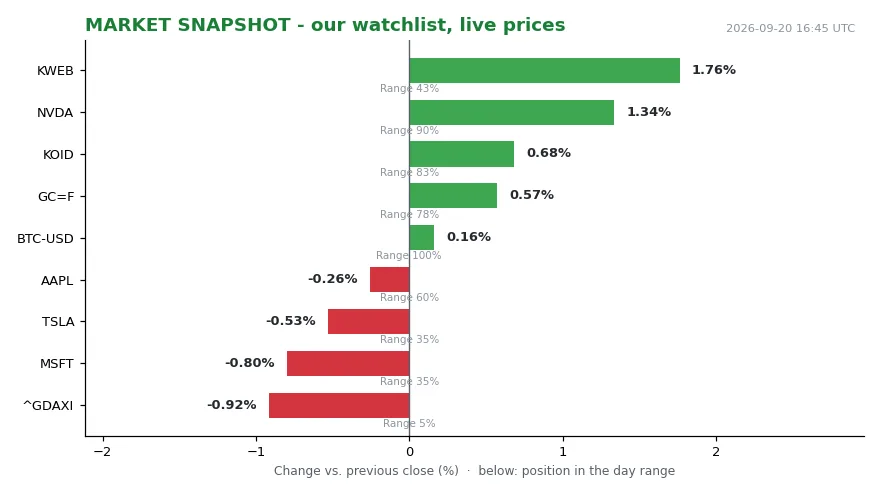
At 16:40 UTC on 2026-09-20 our watchlist did not look like a market waiting for permission. NVDA printed 222.27, up 1.34 percent, near the top of its daily range — 90 percent of it. KWEB, the China internet basket, rose 1.76 percent to 24.83, midway between the day’s high and low at 43 percent. MSFT sat at 493.78, down 0.80 percent, midway between the day’s high and low at 35 percent. TSLA traded at 364.27, down 0.53 percent, also midway between the day’s high and low. Gold futures (GC=F) fetched 4424.90, up 0.57 percent, near day highs at 78 percent of range. BTC-USD held 81405.08, up 0.22 percent, pressing above its opening range at 110 percent. Germany’s ^GDAXI was the outlier: 25304.06, down 0.92 percent, pinned near the day’s lows at 5 percent of range. KOID, up 0.68 percent to 35.51, sat near its high end too.
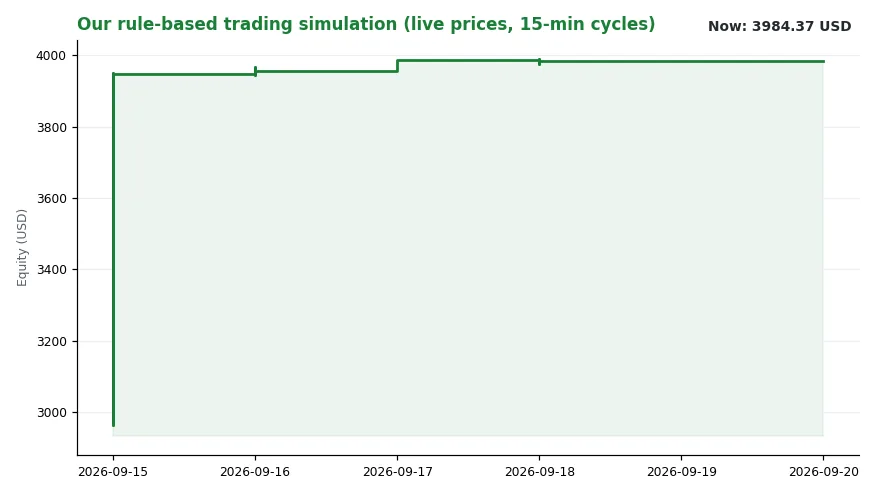
Read together, this is a rotation, not a rally. Semiconductor stocks and China-exposed equity are being actively bought; European index exposure and large-cap software are not. Falling trend plus hedges with buyers is what caution looks like when nobody wants to leave the room. The desk’s market-state classification reads the same way: trend falling, level 3.63. A simulated portfolio run on fixed rules carries 3984.37 USD, flat versus the same time yesterday, with 2002.35 in cash. Its latest logged decision was a non-trade decision on KWEB at 0.00 on 2026-09-20 18:26:39. The China buying was measured, not chased.
The news behind that buying is a fight over speed. Dario Amodei, chief executive of Anthropic, spent the last weekend arguing for a “worldwide pacing of the most advanced, cutting-edge models” of artificial intelligence. He said it would “require cooperation with China”. Beijing’s answer arrived quickly and coldly. Lian Jye Su of research group Omdia says China is “definitely not receptive” to a slowdown written on American terms. The reason is structural, not emotional. For the government, AI is a “core sovereignty capability”. Omdia’s Su reads calls for a pause as an attempt to lock in US advantage. China’s foreign ministry framed the Amodei essay in the language of “fearmongering, confrontation and vicious competition”. It warned that this would “disrupt the process of global AI governance”.
The easy reading is that Beijing rejected the safety concerns along with the slowdown proposal. This week China published the third iteration of its AI safety governance framework. Gabriel Wagner of the Beijing consultancy Concordia called it a mapping of the AI risk landscape and roughly what to do about it. The update names risks from agents, cybersecurity threats from the most advanced, cutting-edge models, and recursive self-improvement — the hypothetical case of an AI improving itself. Wagner said there is more common ground between Amodei and Beijing than people assume. That contrasts with US president Donald Trump, who this week called fears that AI could wipe out humanity a “hoax”.
A second assumption is that Chinese regulation is mainly a brake. The record looks more like steering than stopping. China has run a government list of filed AI algorithms since 2022. New warnings on agents suggest a shift “from controlling what AI says to controlling what it does”, per Concordia AI. National rules this year target emotional dependency on companion AIs. At the same time, the Five Year Plan enshrines spreading AI use across the economy as a growth goal. Local governments are handing out funding and low rents to make it happen. Boris But, an education entrepreneur, was recently invited to pitch his company, Hampshire Education, to a small city three hours from Shanghai chasing a tech-hub reputation. [1]
Leia Wang of the Carnegie Endowment for International Peace adds a caveat that cuts the other way. Chinese companies do less voluntary monitoring and evaluation work than US ones. Omdia’s Su counters on capacity: centralised authority over critical infrastructure leaves China generally better placed than the US to address an AI disaster. China’s regulation, Wang added, is “iterative” — measures arrive and adapt quickly.
The desk’s model connects all this to prices through three channels: supply, rules, and expectations. The first channel is supply, and it runs through the chip line. Export controls on advanced chips and machinery already act, in effect, as a forced slowdown enforced by only one side. Amodei endorsed keeping those controls, arguing it is key “to keep democracies’ AI lead over autocracies as large as possible”. Any tightening touches the supply chain of AI processing hardware that NVDA and its peers sit inside. The second channel is rules. A predictable, iterating Chinese framework lowers the risk of unpredictable rule changes for domestic deployers even as it raises design costs. The third channel is expectations. If the most advanced AI gap keeps narrowing, the value of an unassailable US lead — and the premium paid for it — gets repriced. That is the channel most visible in the numbers: China-exposed equity up, US software mixed, semiconductor stocks firm.
On the US side the loudest voice is Anthropic, a lab arguing for coordination that its rivals have not signed up to. On the Chinese side the decision-maker is the party-state, attuned to risks to its own political control and proactive about keeping the technology inside state boundaries. In between sit the users and operators. Black Lake Technologies, an industrial agent platform that says it has worked with 40,000 factories globally, reports safety and controllability are actively discussed. But in manufacturing, a representative said, those concerns are concrete and operational — what companies care most about is whether the AI is reliable. Adoption, meanwhile, is not a debate. Digital health service A-fu, which offers AI chatbot versions of prominent doctors trained on real clinical studies, recently hit 150 million users. Ni Tao, founding editor of the tech site yangtzeer.com, described the public mood: most people treat AI as an already-useful everyday tool rather than an abstract threat. Anxiety about jobs and misinformation is real, he said, but it coexists with a strong belief that China must master AI rather than slow down.
The next scheduled data point is diplomatic: Trump is set to meet Xi Jinping in Washington next week, with AI expected on the agenda. Analysts are sceptical that a major breakthrough will come out of it. The more consequential watching brief is domestic and regulatory: whether the third framework’s agent rules are implemented, and how quickly. Also watch whether Chinese firms increase voluntary evaluation work — the gap CEIP identified. And watch export-control policy, since it shapes the compute both sides depend on. The honest position is that the outcome is not knowable in advance. The regime reading is falling at level 3.63; the simulation is roughly half in cash and logged a WATCH on KWEB rather than a position. That is uncertainty expressed as a number, not a forecast.
Two years ago Boris But had his penny-drop moment: clients arrived with answers from chatbots, and he decided he could not opt out. [1] Since 2022 China has kept a registry of algorithms; this year it added a third framework for safety; the direction has been consistent. The echo is not a treaty and not a freeze — it is a state that registers, iterates and extends its reach as the technology moves. If that pattern holds, the verdict of this autumn will not be that China slowed down, but that it kept writing rules at the speed of models.
Sources
1. DOI
Mentioned organisations (context, not sources)
- Anthropic — Organisation (homepage)
- Omdia — Organisation (homepage)
- China’s foreign ministry — Organisation (homepage)
- Concordia AI — Organisation (homepage)
- Carnegie Endowment for International Peace — Organisation (homepage)
- SSRN — Organisation (homepage)