
Market state: our measurement. It was not. What they are buying is not a handset. They are buying a promise that machines which write, draw and answer will eventually earn a great deal of money. On 1 October 2026, the governor of the Bank of England used a BBC interview to describe what happens if that promise is not kept. [1]
What the numbers show
Four readings frame the problem. Nvidia, the chipmaker at the centre of the build-out, carries a market valuation of $5.5tn, or roughly £4.14tn, making it the most valuable listed company in the world. [1] Measured against past earnings, US share price valuations are similar to those seen near the peak of the dotcom bubble on some measures, though they look less stretched when measured against expected future profits. The five largest companies account for 30% of the S&P 500’s valuation, the greatest concentration in 50 years. And 30-year gilt yields, the price Britain pays to borrow long, hit their highest level since 1998.
Those four numbers do not describe a crash. They describe concentration, plus a funding market that has already become more expensive. A narrow set of assets carries an unusually large share of the expectation, and the cost of borrowing against that expectation has risen.
The warning
Asked directly whether an AI bubble could burst, his answer was conditional rather than dramatic: “You could see some correction of asset prices at some point.” [1] The technology has “great potential to strengthen growth in our economies”, and the country needs that. “But it also brings with it substantial risks and so we have to be on top of both of those.” [1] The Bank’s Financial Policy Committee described the risk of spillovers from such a shock into Britain’s financial system as “material.
The channels
Valuation. Alphabet, Meta, Microsoft and Amazon have committed hundreds of billions of dollars to the technology, and two of the largest AI developers, Anthropic and OpenAI, are preparing to sell shares on the US stock market — moves expected to draw hundreds of billions more into the industry. [1] Much of this has been spent or loaned in the hope of large returns. [1] Bailey’s description of the resulting market is blunt: “Everybody is currently priced to be a winner.” [1] His historical analogy is Netscape, the early browser maker that led internet search before Google did. “Google was not the first market leader in internet search. It was Netscape. Nobody can remember Netscape today. It doesn’t exist. So not everybody always wins.” The Bank attributes the recent climb in gilt yields to the difficulty of reining in high borrowing across advanced economies, amplified by political uncertainty in France and Japannd JapaFederal Reserve credibility. The Bank flagged a second, separate trigger: a “sudden or significant change in perceptions of Federal Reserve credibility” could produce “a sharp repricing of U.S. dollar assets, including in U.S. sovereign debt markets, with the potential for increased volatility, risk premia and global spillovers”. President Donald Trump has repeatedly urged the US central bank to cut rates and has sought to remove one of its policymakers, Lisa Cook. British borrowing costs are closely correlated with US Treasury yields, so a fall in US bond prices would probably raise the cost of servicing new British public debtlic debt.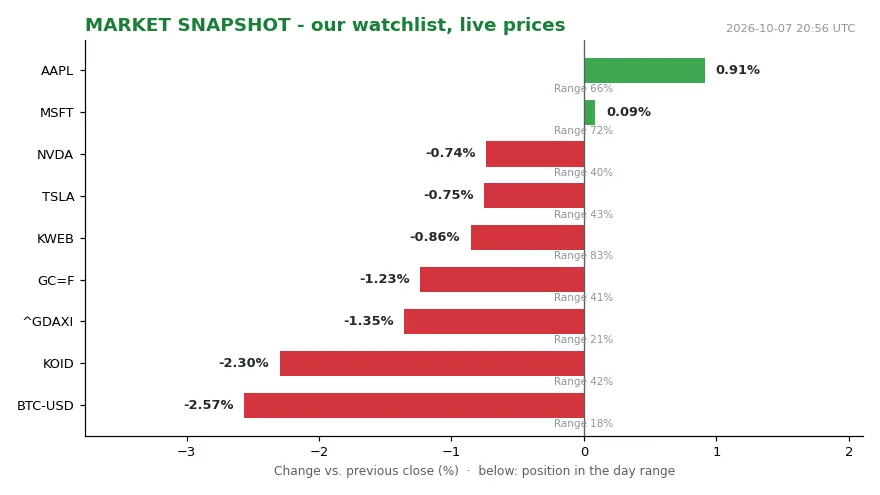
Then there are deepfakes. In June, fake images depicting Bailey and Nigel Farage in a physical fight were promoted on the social platform X. [1] The Bank struggled to establish where they came from. The quality of such material, Bailey said, is “alarming”. [1]
The actors
The gains so far are legible: Nvidia’s valuation, the platforms’ scale, the equity that AI developers are about to offer to public investors. [1] The losses are not yet distributed. They land on whoever is priced as a winner and turns out not to be. [1] The decisions sit in a few rooms. The Financial Policy Committee sets the resilience agenda. The Fed sets the dollar conditions that Britain imports through its own bond market. And the technology sector holds a lever Bailey explicitly asked it to use, on traceability. [1] On regulation he has been cautious about sequencing: AI needs “rigorous” testing and safeguards to contain risk, but regulating it is “not the right place to start”. The IMF, in its Global Financial Stability Report, warned that asset prices risk a “collapse” if tech stocks fail to meet expectations, and that concentration risk is now substantially higher than during the dot-com bubble.
The Bank’s own Monetary Policy Committee already benefits from it, in Bailey’s account, through “speeding up the work that supports the Monetary Policy Committee [MPC]”. “It’s not taking a decision, but it’s a tool in the hands of the policy maker and that’s good.” [1]
What to watch
Four things to watch. The pricing of the Anthropic and OpenAI share sales may test whether public investors accept the private valuation story. [1] The 30% concentration figure will show whether risk is spreading or narrowing. Any signal on Fed independence could move Treasury markets first and gilt yields shortly after. Energy prices will shape the next rate decision. And the testing and traceability regimes Bailey asked for will either appear or not. [1] “We are prepared for the fact that there will be, I think, some shocks come along to markets and we have to deal with that. We have to make sure the system is resilient.” [1]
Sources
[1] BBC News, “AI boom could trigger market shocks, Bank of England boss warns”, interview with Andrew Bailey by Mitchell Labiak and Faisal Islam, 1 October 2026.
BBC News, Bank of England topic coverage: “Regulating AI ‘not the right place to start’ says Bailey”; interest rate decision, 17 September 2026.
Bank of England Financial Policy Committee quarterly update, reported by Reuters via Yahoo Finance.
TBS News English, video summary of the Bank of England warning.
IMF Global Financial Stability Report, reported via Yahoo Finance.
—