Aviva Warns New Homes Could Become Uninsurable
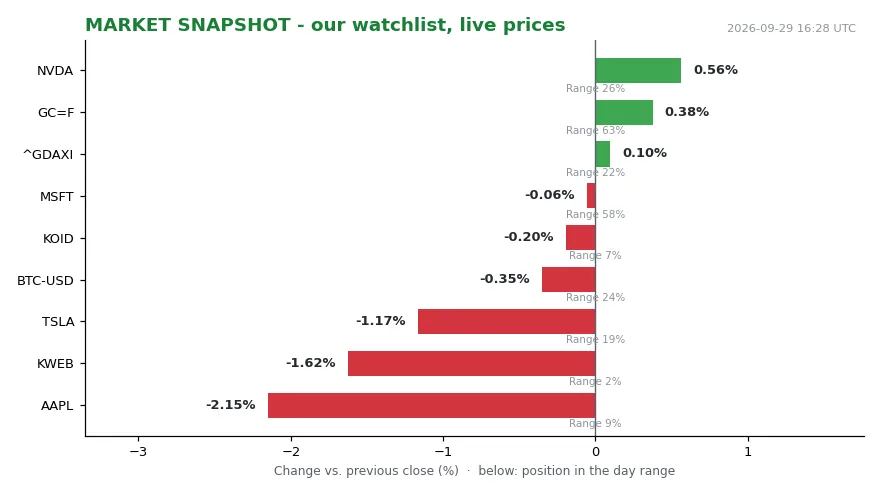
As of 2026-09-29 16:23 UTC, NVDA trades at 230.16, up 0.57 % against the previous close and 26 % of the way between its day’s low and high. AAPL prints 330.70, down 2.28 %, pinned near its day lows with just 2 % of the range beneath it. MSFT barely moves at 508.94, down 0.05 %, 58 % of the way between its day’s low and high. KWEB slides 1.62 % to 24.26 and sits at 2 % of its range. Gold, GC=F, gains 0.40 % to 4185.20 and holds 65 % of its range. TSLA at 353.58, down 1.08 %, keeps 23 % of its range. BTC-USD at 83167.72, down 0.38 %, keeps 22 %. ^GDAXI at 25399.21, up 0.10 %, also holds 22 %. KOID at 35.80, down 0.22 %, holds only 5 %. Our regime reading, a coded label for the current market state, says trend=falling, level=3.63. The simulated book, a paper portfolio tracked for illustration, stands at 4011.20 USD, down 0.03 % versus the same time yesterday, with cash of 2008.28. The latest logged decision was BUY AAPL at 15:56:33. This is a shallow drift lower, not a break, and the defensive bid is thin. What is absent from the list matters more. No ticker in it carries a flood map, and no line item carries the insurability of a house. That missing number is where the news arrives.
The number Aviva put on the map
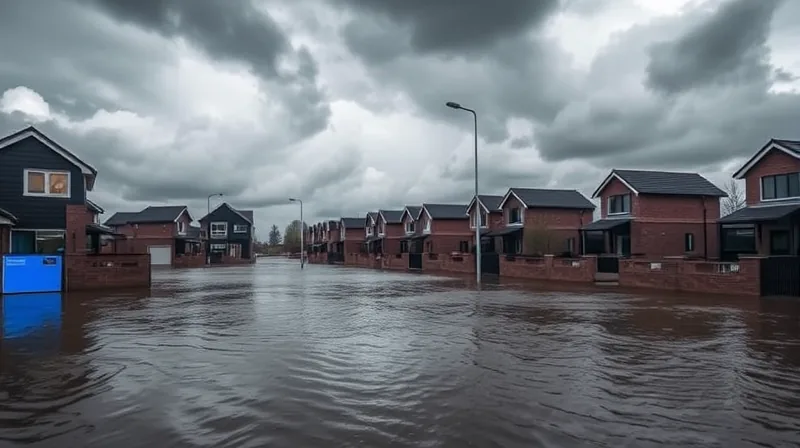
Amanda Blanc, chief executive of Aviva, Britain’s biggest insurer, has warned that homes being built now in England could become uninsurable in the future because they are sited in flood-risk areas. Blanc said the flooding threat was ‘absolutely increasing’. The mechanism she describes is siting: where a house stands decides whether it can be covered at all, and the construction pipeline keeps adding addresses to the mapped zones faster than the map is redrawn. Two passages from the interview carry the mechanics. The first describes how the water arrives: > “You’ve seen a very dry summer, and what happens if you then get heavy rain on very dry surfaces is you get more surface water flooding.” [1] > — Amanda Blanc, chief executive of Aviva, on the BBC’s Big Boss Interview podcast The second explains why an insurer cannot simply charge more: > “If you think that there’s an inevitability of something happening, that’s not what insurance is, right? Insurance is a pool where you know there’s a risk that something happens for some people and not for others. When there is an inevitability, it makes it very difficult for it to be insured.” [1] > — Amanda Blanc, BBC Big Boss Interview podcast And a third, addressed to the people who draw the plans:
> “It’s very well known where these flooding areas are. Let’s think very carefully about homes that are being built.” [1] > — Amanda Blanc, BBC Big Boss Interview podcast
How a wet house becomes an unsellable house
Insurance sits at the front of a chain that ends on a bank’s balance sheet, and the chain has four links. The first is the pool itself: premiums, the regular payments a policyholder makes for insurance cover, work when losses are uncertain across a group, and they stop working when a loss becomes near-certain for a specific address. The second link is the lender, because a mortgage usually requires cover, and a house that cannot be insured is a house that cannot easily be mortgaged. The third link is price discovery, the process by which buyers and sellers settle on a market price, which runs in reverse: no cover means fewer buyers, and fewer buyers means a slower market and a lower clearing price. The fourth link is public, since abandoned or blighted housing stock lands on councils and on the taxpayer. None of these links moves on a single day. That is precisely why nothing in our watchlist reflects them yet. A separate channel runs through pensions, and it is closer to the tape. Blanc has urged ministers to avoid policy “kite flying” — publicly floating a policy idea to test reaction before committing to it — before the budget. Aviva is Britain’s biggest insurer. The scale, in her account:
Three ways to read a flood-prone house
The first reading is the tape reading: risk is priced continuously, and anything not visible in prices is not yet a market fact. Our own ranges support the first half of that claim and are silent on the second — a snapshot cannot tell us what happens next, and we will not pretend otherwise. The second is the actuarial reading, which Blanc sets out: an insurer can only pool a risk that is uncertain for any single address. The third is the build-and-mitigate reading, which argues that vulnerability is a design choice rather than a location: > “You can do all sorts of different things to your property to make it more or less vulnerable to flood.” > — Amanda Blanc, BBC Big Boss Interview podcast Those are real options, and they are per-property options. The scale is what decides between the readings: an insurer’s exposure is an aggregate, while mitigation is a household decision. A household can adapt. A national housing stock has to be sited well in the first place. **### Who wins, who loses, who decides. The gainers are insurers that hold pricing power and reinsurers that can reprice or withdraw, plus builders who can move to safer land. The deciders are planners and housebuilders, who choose the sites, and the government, which sets the budget line and the planning rules. The Environment Agency supplies the map that everyone agrees exists. Aviva, as both insurer and pension provider, sits on two sides of the same table. Our own simulated book — cash of 2008.28 and a fresh AAPL position at 333.01 — is a participant in none of it, which is the honest description. Nothing here is advice; the log exists so the reasoning can be checked later. **### What we watch next. The 28 October budget, and whether pre-budget speculation produces another withdrawal spike. Aviva’s flood-risk counts, which we expect to be revised as the 2050 estimate is updated. The Environment Agency’s flood map, which is the only shared coordinate system in this argument. And the UK winter itself, whose rainfall statistics now arrive on a different frequency than the one the 1-in-80 estimate was built on. On our side, the signal layer logged its busiest channel on 2026-09-28 as ‘central banks’ with 2 events, and the regime reading remains trend=falling at level=3.63. Our book moved 0.03 % against the same time yesterday. Those are small numbers, and we report them as small. The map that matters here carries no latitude and no longitude. Its grid lines are the outlines of English flood zones, already drawn and already public. Its next fixed point is the budget, and its slowest-moving line is a mortar joint in a house that has not been built yet.