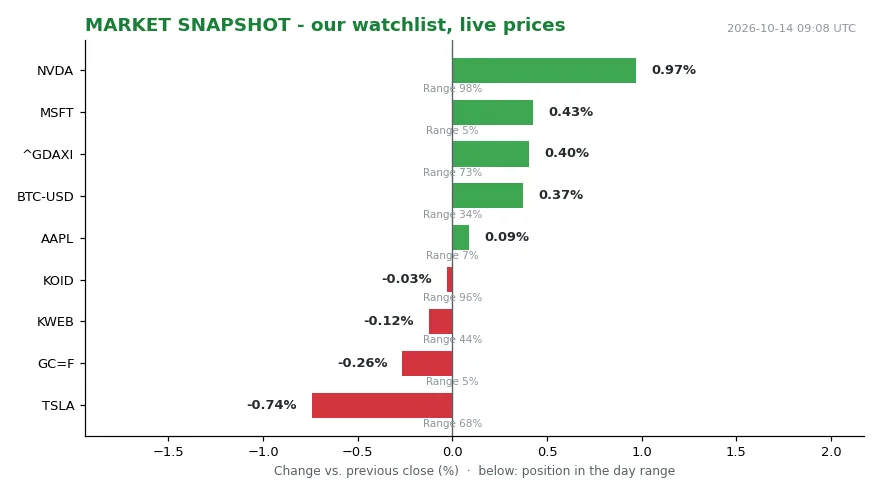
Our own tape, pulled at 11:02 UTC on 14 October, frames the session. Nvidia prints at 228.52 dollars, up 0.97 percent, and sits at 98 percent of its daily range. Microsoft trades at 543.45 dollars, higher on the day, but at just 5 percent of its range. Apple sits at 341.27 dollars, essentially flat, at 7 percent of its range. Three mega-cap technology names are green. Two of them are pinned near the floor.
The dispersion is the message. Money is not moving into technology as a block. Our screen suggests it is moving into the firms that supply the physical build-out of AI.
Our other readings agree, with one caution. The German DAX stands at 25,366.92 points, up 0.42 percent, at 78 percent of its range. KOID prints at 34.67 dollars, marginally lower, at 96 percent of its range. Gold is at 4,167.00 dollars, down 0.25 percent, at 8 percent of its range. KWEB trades at 24.72 dollars, slightly lower, mid-range at 44 percent.
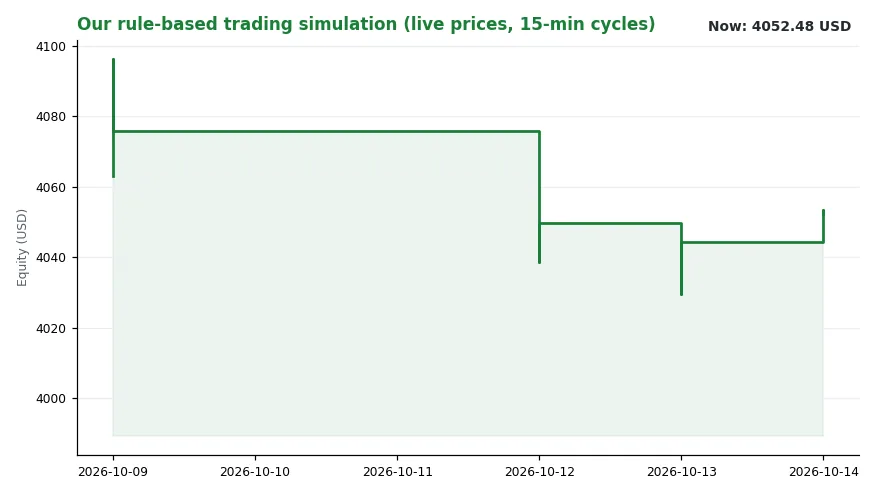
The caution sits in our regime reading. Trend is marked falling, at a level of 3.63. Our rule-based paper portfolio holds 4,053.25 dollars, up 0.22 percent against the same time yesterday, with 2,023.60 dollars in cash. The latest log entry is a watch instruction on KWEB, timestamped 10:51:51, with no trade attached. Central banks are the busiest signal channel of the day, with one event.
Now place the news on top of that screen. ASML, the Netherlands-based supplier of equipment to the semiconductor industry, reported its highest-ever quarterly sales on Wednesday. Third-quarter sales reached 11.7 billion euros. Net income came in at 4.96 billion euros. The company also raised the bottom of its 2026 sales forecast.
Two statements about ASML are true at once. It has never sold more machines. It will not be able to build enough of them. The first comes from the income statement. The second comes from the outlook.
What ASML Told the Market
ASML’s current production plans will not fully meet customer demand in 2027 and 2028. The driver is AI investment, which keeps pushing orders higher.
The quarterly detail matters. Third-quarter sales were 11.66 billion euros, up 55 percent from a year earlier. That sits near the top of ASML’s own 11 to 12 billion euro forecast.
Gross margin came in at 57.5 percent, above the company’s own forecast. Servicing and upgrading customers’ existing machines contributed 3.3 billion euros. Net income was helped by a 510 million euro gain on stakes ASML holds in other companies.
Guidance moved as well. ASML now expects 2026 sales of 44 to 45 billion euros, up from 43 to 45 billion, with a gross margin of around 56 percent, up from 54 to 56 percent. For the fourth quarter it forecasts sales of 14.2 to 15.2 billion euros.
Then comes the part that explains the reaction. ASML has set out plans to expand capacity by 30 % in 2027. That covers both low-NA extreme ultraviolet machines and deep ultraviolet immersion machines. Now the company is looking past even that. [1] “We are investigating ways to increase capacity for 2028 beyond the 30% increase we previously communicated.” — Christophe Fouquet, chief executive of ASML, in a statement. “Customers are asking us every single day to get more tools.” — Christophe Fouquet, in a video interview released alongside the results. [1]
The mechanism
That is a channel, not a mood. Chipmakers order this equipment well in advance. An order placed today reaches a factory floor years later. The order book therefore works as a forward indicator of capital spending. Investors read ASML’s outlook as a test of whether AI spending plans hold up.
A capacity shortage behaves differently from a demand shortage. A demand shortage is absorbed by price cuts or by walking away. In our reading, a capacity shortage is absorbed by buildings, engineers and time. On our reading, ASML can raise prices, but it cannot conjure a factory inside a quarter.
The technology split sharpens the point. EUV systems are the scarce, non-substitutable part of the portfolio. DUV immersion tools are being expanded too, but they sit further back in the chain.
Then there is the balance-sheet channel. That revenue comes from machines already standing inside customer factories. It arrives whether or not new orders are signed.
The guidance change travels through expectations, not cash. Raising the floor of 2026 sales looks modest. Its function is to remove one downside scenario from the table.
The players
Start with the person carrying the message. Christophe Fouquet runs ASML, and both quotes above come from him. One is a statement of intent on 2028 capacity, the other a description of daily pressure from buyers.
Then come the buyers. Taiwan’s TSMC is the world’s biggest contract chipmaker and a major ASML customer. It reports on Thursday. That release will confirm the demand picture or complicate it.
The wider cast matters too. Analysts read the print as a catch-up rather than a surprise. “ASML delivered a strong set of numbers, but realistically, they have only caught up to where the market already was with its expectations.” — Ben Barringer, head of technology research at UK wealth manager Quilter Cheviot.
ASML’s Amsterdam-listed shares were up by more than 3 percent at around 10:00 CEST on Wednesday. That is a gain, not a repricing.
The supplier gains pricing power and visibility, for as long as the build-out lasts. Buyers gain certainty about direction and lose certainty about timing. Anyone outside the EUV market gains little, because there is nothing to buy from them.
What we watch next
Two scheduled events sit directly ahead. ASML’s investor call is at 15:00 CEST on Wednesday. Taiwan’s TSMC reports on Thursday.
The harder question is further out, and it is about time rather than money. “Durable growth will continue into 2027 and 2028, however, the market will begin asking the question of whether or not there will be any sign of a downturn from 2029 and what impact that has for ASML.” — Ben Barringer, Quilter Cheviot.
They are bets on a window. If the window closes earlier than customers expect, capacity built for 2027 becomes cost. If it stays open longer, the constraint stays binding.
What we do not know is large. The investor call and TSMC’s report on Thursday will either confirm the demand picture or complicate it. Our own regime reading, with trend falling at 3.63, is a reminder that our data does not settle the argument either.
ASML reported record sales, raised the floor of its 2026 guidance and said its plans will not fully meet customer demand. The market answered with a gain of more than 3 percent and no great drama. The constraint is physical, not financial: buildings, engineers and time. That is the pattern our screen is already pricing.